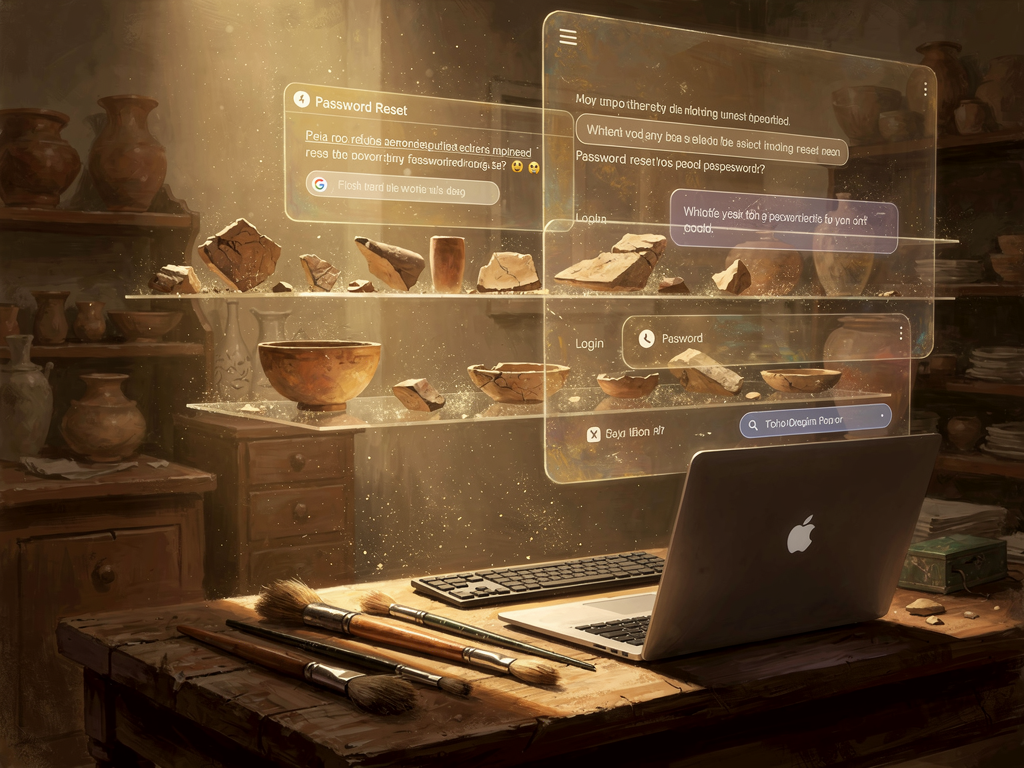
The Archaeology of Forgotten Passwords and Digital Amnesia
Somewhere in the vast digital sediment of our lives lies a password you created three years ago—perhaps “Sunshine2021!” followed by the inevitable “Sunshine2022!” and its desperate descendant “Sunshine2023!@#”. Like pottery shards in an ancient settlement, these forgotten credentials tell the story of who we once were, what we valued, and how we tried to remember ourselves.
The Stratigraphy of Digital Memory
Digital amnesia—the phenomenon where we forget information we trust our devices to remember—has created its own archaeological record. Each forgotten password is like a fossil, preserving a moment when we believed we’d surely remember that clever combination of our cat’s name and our anniversary date. The Kaspersky Lab, which coined the term “digital amnesia,” found that we’ve essentially outsourced our memory to silicon and cloud storage, creating a peculiar form of collective forgetting.
But what fascinates me most isn’t the forgetting itself—it’s what these digital artifacts reveal about our relationship with memory and identity. When I excavate my own password manager, I find layers of self like geological strata: the optimistic phase when I thought I could remember everything, the security-conscious era of complex character combinations, and the current age of randomly generated strings that mean nothing to human consciousness.
The Paradox of Perfect Recall
Our devices remember everything and nothing simultaneously. Your phone knows every WiFi password you’ve ever entered, every contact you’ve saved, every photo you’ve taken—yet ask it for the password you created last week, and you might find yourself locked out of your own digital life. This creates what researchers call a “Google effect” or “digital amnesia,” where we’re more likely to remember where information is stored rather than the information itself.
Consider the absurdity: we live in an age of unprecedented information storage, yet we’ve never been more forgetful about the keys to our own digital kingdoms. It’s as if we’ve built the most elaborate filing system in human history but keep misplacing the index.
The Archaeological Method Applied
Like archaeologists studying ancient civilizations through their refuse, we can understand our digital habits through our forgotten passwords. The evolution from “password123” to “P@ssw0rd123!” to “kX9#mQ8$vL2%” tells a story of growing security awareness, increasing complexity, and ultimately, the surrender to algorithmic generation.
But here’s where the metaphor becomes tender: unlike ancient pottery, our digital artifacts aren’t just functional—they’re deeply personal. That password containing your childhood pet’s name isn’t just a security measure; it’s a small monument to memory, a digital headstone for something you once held dear.
The Neuroscience of Letting Go
Nancy Dennis, a Penn State psychology professor, suggests that digital amnesia isn’t necessarily harmful—it might be freeing our brains for more important cognitive tasks. When we stop memorizing phone numbers, we create mental space for creativity, problem-solving, and deeper thinking. Perhaps forgetting passwords is an evolutionary adaptation, a cognitive efficiency that allows us to focus on what truly matters.
Yet there’s something profoundly human about the struggle to remember these digital keys. We create passwords based on meaningful dates, beloved names, inside jokes—then watch helplessly as they slip from memory, taking small pieces of our personal mythology with them.
Toward a Digital Archaeology of Self
Maybe we need to approach our forgotten passwords not as failures of memory, but as artifacts of a life lived across multiple digital dimensions. Each forgotten credential is evidence of a moment when we tried to bridge the gap between human memory and machine precision, between the warmth of personal meaning and the cold efficiency of security protocols.
The archaeology of forgotten passwords reveals something beautiful and melancholy about digital existence: we’re constantly creating, losing, and recreating the keys to our own virtual selves, leaving behind a trail of abandoned access points like ancient ruins in the cloud.