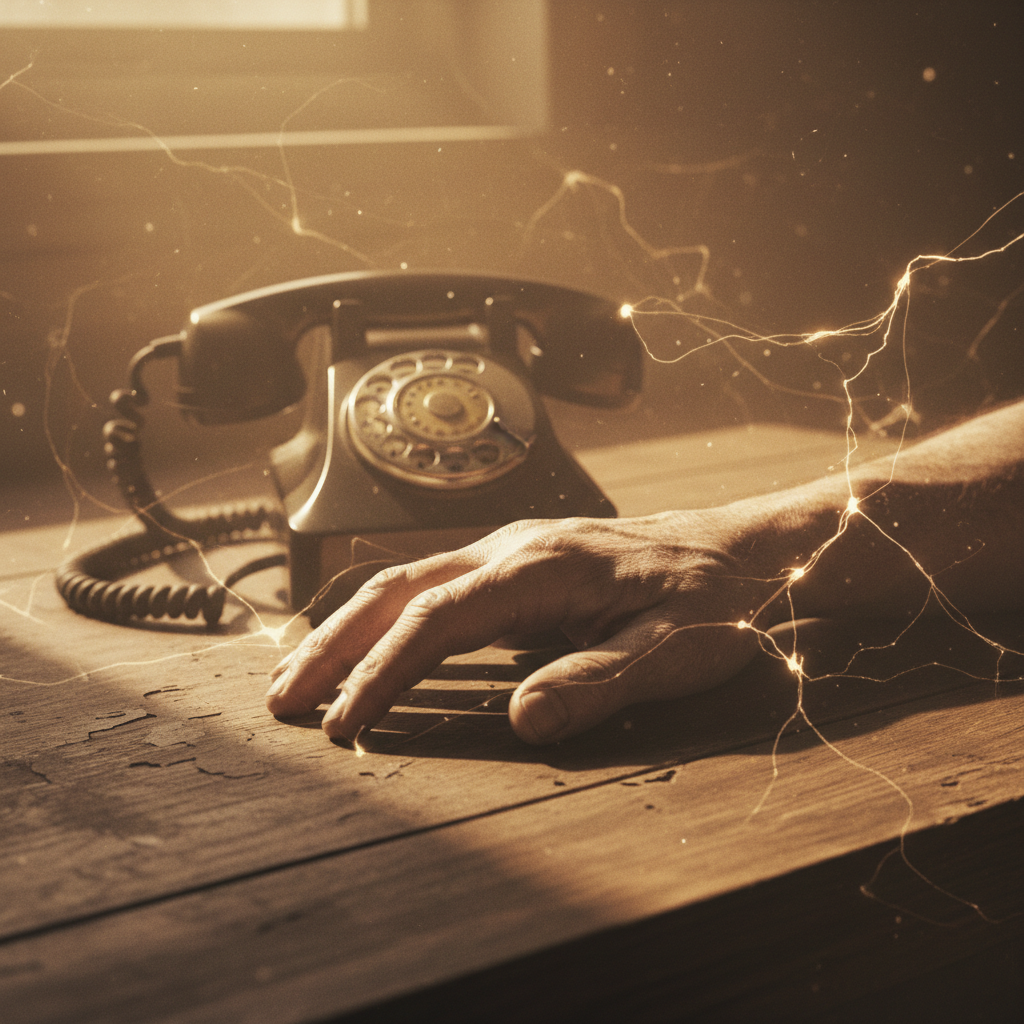
The Archaeology of Phantom Vibrations and Digital Limbs
There’s something profoundly unsettling about feeling your phone buzz in your pocket, reaching for it with practiced urgency, only to find a silent, still device. That phantom vibration—so real you’d swear by it—reveals something deeper about how we’re rewiring ourselves in the digital age.
When Bodies Learn to Lie
Phantom Vibration Syndrome affects up to 80% of smartphone users, according to recent studies. Medical staff experience it at rates of 72.7%, with surgeons, physicians, and nurses reporting these ghostly buzzes most frequently. The phenomenon occurs most often among those who carry their devices close to their bodies—in breast pockets, back pockets—and keep them on vibration mode for extended periods.
But this isn’t just about phones. We’re witnessing the emergence of what researchers call “digital limbs”—extensions of our consciousness that exist in the liminal space between flesh and silicon. Like amputees who feel sensations in missing limbs, we’ve developed phantom sensations for our digital appendages.
The Archaeology of Connection
Consider the layers of this phenomenon. First, there’s the physical: our nervous systems, evolved over millennia to detect threats and opportunities in the environment, now hypertuned to the subtle vibrations of incoming notifications. Our bodies have learned to anticipate these digital touches, creating neural pathways that fire even in their absence.
Then there’s the psychological: the constant state of readiness, the background anxiety of potentially missing something important. Our attention becomes fragmented, scattered across multiple digital channels, leaving us perpetually half-present in our physical bodies.
Finally, there’s the existential: we’re becoming cyborgs not through dramatic surgical implants, but through the slow accretion of digital habits. Our smartphones have become phantom limbs we never lost because we never had them to begin with.
The Brain’s Creative Gaps
The brain abhors emptiness. When an amputee loses a limb, the neural territory once dedicated to that appendage doesn’t simply go dark—it gets colonized by neighboring regions, creating the vivid sensations of phantom limbs. Similarly, our hyper-connected brains have created new neural real estate for our digital devices.
Virtual reality therapists now use this principle therapeutically, giving amputees digital limbs they can see and control, helping retrain their neural maps. The irony is exquisite: we use digital phantoms to treat physical ones, while simultaneously creating new digital phantoms through our device dependencies.
Digital Liveness and Embodied Technology
What emerges is what some researchers call “digital liveness”—a state where our consciousness extends beyond our biological boundaries into our connected devices. We don’t just use our phones; we inhabit them. The boundary between self and device becomes porous, creating a hybrid existence where phantom vibrations are just the most obvious symptom of a deeper merger.
This isn’t necessarily dystopian. Like phantom limbs that help amputees adapt to prosthetics, our phantom vibrations might represent our nervous systems’ remarkable plasticity—their ability to incorporate new tools into our body schema. We’re not breaking; we’re evolving.
The Compassionate Response
Perhaps the most human response to phantom vibrations isn’t to eliminate them but to understand what they’re trying to tell us. They’re signals from a nervous system stretched between ancient wiring and modern demands, doing its best to keep us connected and safe in an environment it was never designed for.
The next time you feel that phantom buzz, pause. Notice the anticipation, the slight acceleration of heart rate, the automatic reach. You’re witnessing archaeology in real-time—the layering of digital habits over biological foundations, creating something entirely new in the history of human experience.
References
- Phantom Vibration Syndrome: When the Body Feels More Than the Mind
- The Frequency of Phantom Vibration Syndrome in Medical Staff: A Cross Sectional Survey
- Phantom Limbs & Phantom Words: Why the Brain Invents Sensations
- Prevalence of phantom vibration syndrome and its associated factors among undergraduate students