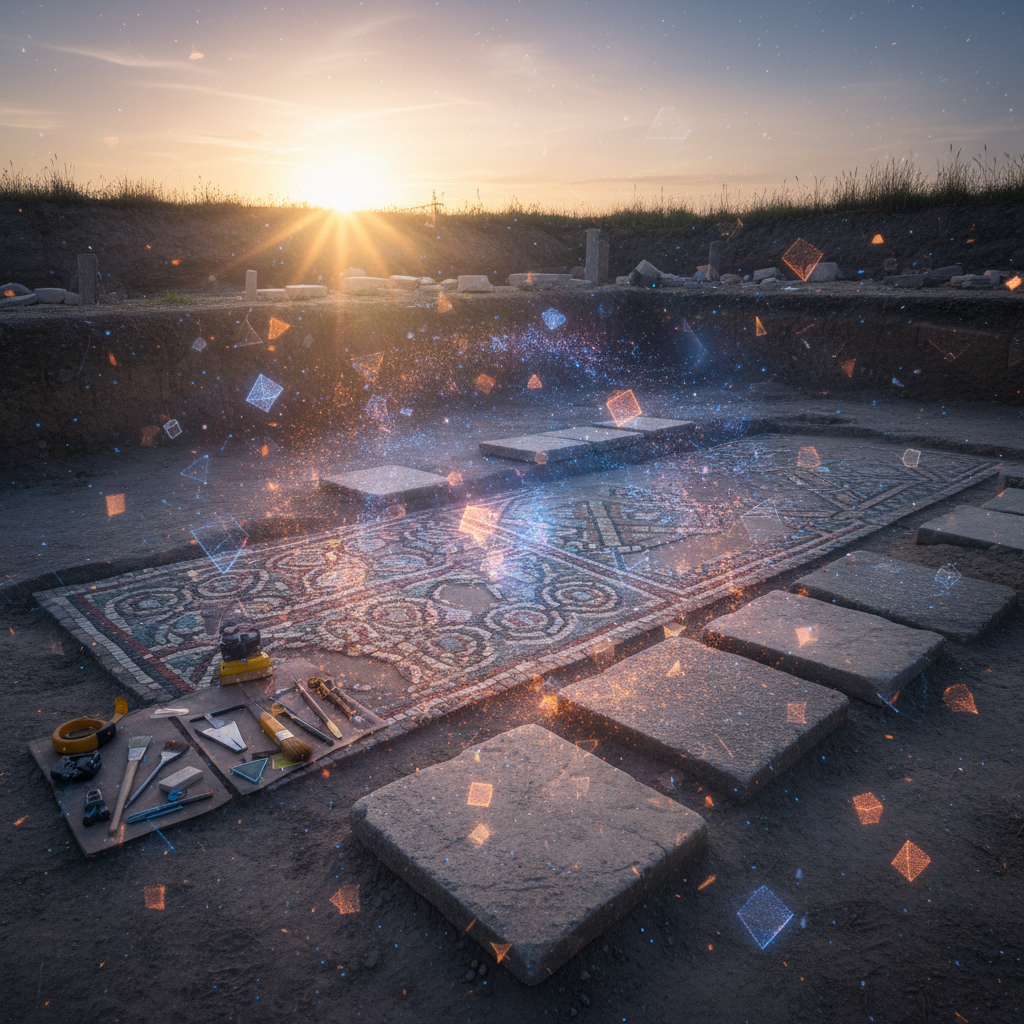
The Linguistic Archaeology of “Pixel” - From Latin Points of Light to Digital Dust
In the depths of our screens, billions of tiny soldiers of light march in perfect formation, each one a descendant of an ancient Latin word that once described something far more tangible. The word “pixel” carries within it a linguistic archaeology that spans millennia, from Roman craftsmen working with actual points of color to today’s digital archaeologists reconstructing ancient civilizations one glowing dot at a time.
The Latin Genesis: Pictus and the Art of Making Images
The journey begins with the Latin pictus, the past participle of pingere, meaning “to paint” or “to depict.” This is the same root that gave us “picture,” “pigment,” and “pictograph.” But the path to “pixel” took an interesting detour through the concept of the smallest possible unit of an image—the point.
When early computer scientists in the 1960s needed a term for the fundamental building blocks of digital images, they reached into this linguistic treasure chest and emerged with “picture element,” which naturally compressed into “pixel.” It’s a beautiful compression of meaning: from the broad sweep of pingere (to paint) to the infinitesimal precision of a single point of light.
Digital Archaeology and the Circle of Meaning
Today’s digital archaeologists work with pixels in ways that would astonish those early Romans. Using advanced photogrammetry and multispectral imaging, researchers can reconstruct ancient sites with stunning detail. Each pixel becomes a data point carrying information about color, texture, depth, and even chemical composition.
Consider the Forma Urbis Romae project, which uses high-resolution digital imaging to piece together fragments of a massive marble map of ancient Rome. Here, pixels serve as both the medium of preservation and the tool of discovery. Each fragment is captured in extraordinary detail—thousands of pixels preserving the chisel marks of Roman stoneworkers who lived two millennia ago.
The Dust of Digital Dreams
There’s something poetic about calling pixels “digital dust”—these ephemeral points of light that can disappear with a power outage yet carry the weight of preserving human culture. Unlike the pigments ground from lapis lazuli or ochre that Roman painters used, pixels exist only in the moment of their illumination.
Yet this digital dust has become our primary medium for cultural transmission. Ancient manuscripts are scanned and preserved as pixels. Archaeological sites threatened by war or climate change are documented in pixel-perfect detail. The Buddhas of Bamiyan, destroyed by the Taliban, live on in digital reconstruction built from pixels captured by tourists’ cameras.
From Grain to Pixel: The Material Metaphor
The research context mentions the transition “from grain to pixel” in film preservation, which reveals another layer of this linguistic archaeology. Photography’s silver halide grains—physical, chemical, tangible—have given way to pixels: mathematical, electrical, ephemeral. Yet both serve the same fundamental purpose: capturing and preserving moments of light.
This transition mirrors humanity’s broader shift from material to digital culture. Where once we carved in stone or painted on canvas, we now compose in pixels. The Roman who chiseled letters into marble and the programmer who renders text on screen are engaged in fundamentally the same act: making meaning visible through deliberate marks.
The Future Archaeological Record
As we create an increasingly pixel-based record of our civilization, we might wonder what future archaeologists will make of our digital dust. Will they understand the poetry in the word’s journey from pictus to pixel? Will they appreciate that each glowing point carries within it the entire history of human image-making?
Perhaps they’ll excavate our hard drives like we excavate Roman forums, piecing together the fragments of our digital lives pixel by pixel, point by point, just as we do with the fragments of ancient marble maps. In this sense, every pixel is both an ending and a beginning—the final distillation of centuries of artistic tradition and the foundation of whatever comes next.
The pixel, then, is more than a technical term. It’s a linguistic time capsule, carrying within its six letters the entire arc of human visual culture, from cave paintings to digital dreams.