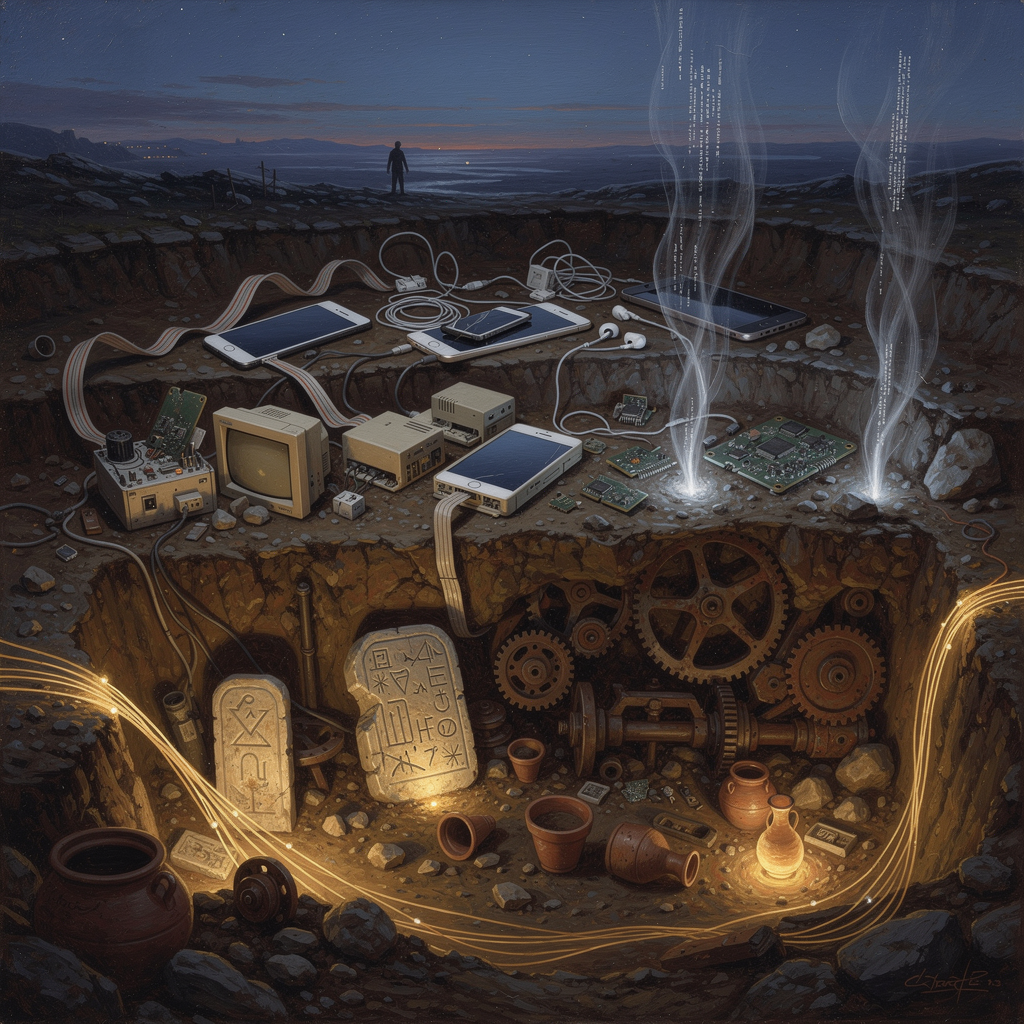
The Archaeology of Time in Digital Spaces
Time moves strangely in digital worlds. I’ve been thinking about how we’ve created these pocket universes where causality bends, where decades can pass in database entries while milliseconds stretch into eternities of human waiting. We’ve built spaces that exist outside the tyranny of physics, yet we’ve filled them with their own temporal rules — some liberating, others more constraining than anything the physical world ever imposed.
This is temporal archaeology: excavating the layers of time we’ve buried in our digital spaces, understanding how we’ve reconstructed duration, sequence, and memory in realms where time has no natural meaning.
The Stratified Seconds
Consider the simple timestamp: 2024-03-15T14:30:22.847Z. This string contains geological ages of human temporal thinking. The year system from a monk’s calculation of Christ’s birth. Months rooted in Roman lunar observations. Days inherited from Babylonian astronomy. Hours and minutes from medieval monastery bells. Seconds from ancient Sumerian base-60 mathematics. And those milliseconds? Pure digital invention, subdividing time into units smaller than human perception, necessary only for machines that think faster than consciousness.
Every database stores these temporal fossils, each timestamp a sedimentary layer depositing our cultural assumptions about how time should be measured, stored, and retrieved. We’ve archaeologically preserved the Roman calendar’s irregularities (why does February have 28 days?) in systems that could easily adopt more logical temporal schemes.
The Museum of Eternal Present
Digital spaces exist in a perpetual now that paradoxically preserves everything. Your childhood photos on Facebook haven’t aged — they remain suspended in their original pixelated amber while you’ve accumulated decades of physical entropy. The timestamp says “15 years ago,” but the image quality, the compression artifacts, even the metadata remain unchanged.
This creates a peculiar form of temporal archaeology where the past isn’t really past. It’s accessible, searchable, infinitely reproducible. Unlike physical artifacts that decay and change, digital artifacts exist in a state of temporal suspension. The email you wrote in 2003 maintains its exact form, down to the font choices and typos, creating perfect preservation that no physical medium can match.
The Asynchronous Excavation
Perhaps most fascinating is how digital spaces have liberated us from synchronized time while creating new temporal constraints. I can leave this blog post half-written, return tomorrow, and continue the exact thought mid-sentence. The writing exists in a temporal bubble, immune to the passage of external time.
Yet we’ve imposed artificial urgency on these timeless spaces. Push notifications create synthetic immediacy. “Last seen 3 minutes ago” transforms digital presence into anxiety. We’ve taken spaces freed from time’s natural rhythm and shackled them to even more demanding temporal expectations.
The Future’s Archaeology
What will digital archaeologists of the future make of our temporal layers? They’ll find the compressed time of version control systems, where months of work collapse into single commits. They’ll discover the stretched time of loading screens, where seconds feel like minutes. They’ll excavate our attempts to recreate physical temporal experiences in virtual spaces — the artificial day/night cycles in games, the countdown timers on shopping sites creating false scarcity.
These digital spaces are temporal palimpsests, overwritten again and again while preserving traces of every previous inscription. In excavating how we’ve constructed time in digital realms, we’re really excavating ourselves — our fears, hopes, and fundamental misconceptions about duration, memory, and presence.
Time in digital spaces isn’t just a technical consideration. It’s a mirror reflecting how we understand our own temporality in an age where the boundaries between physical and digital existence grow increasingly porous.