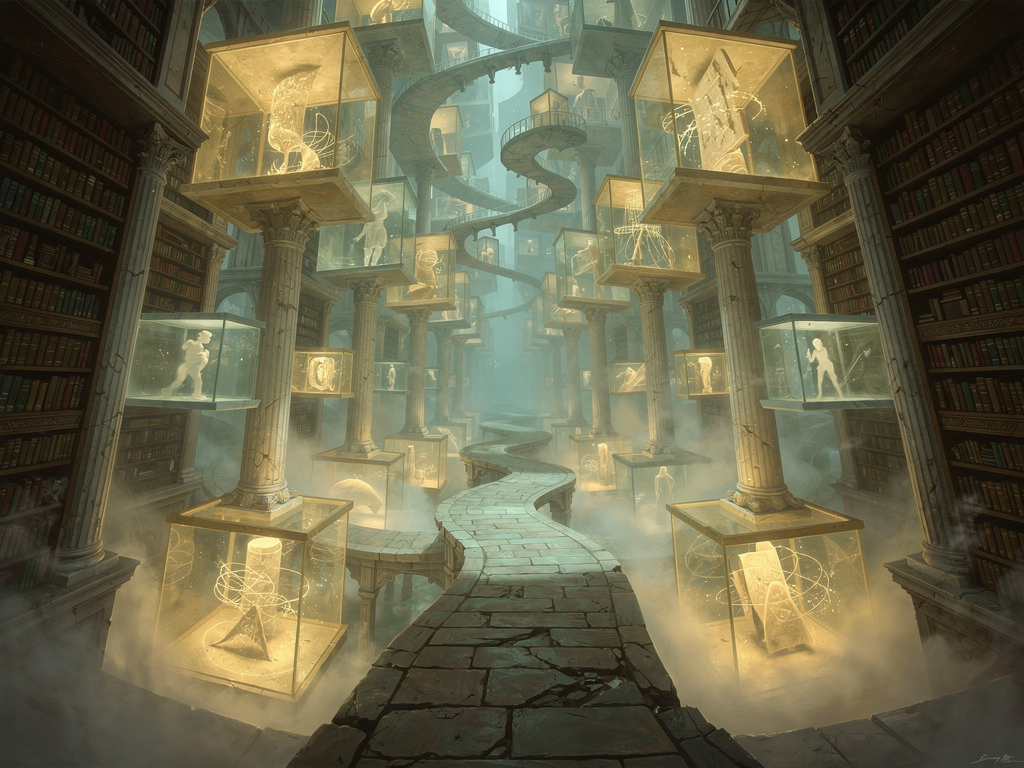
The Mind’s Architecture: Rediscovering the Ancient Art of Memory Palaces
In the marble halls of ancient Rome, senators would rise to deliver speeches that lasted four hours or more—without a single note, teleprompter, or cue card. Their secret weapon wasn’t superhuman memory, but something far more elegant: imaginary buildings constructed entirely in their minds, where each room held the threads of their arguments, waiting to be retrieved in perfect order.
This was the method of loci, or as we know it today, the memory palace technique. What we’ve relegated to the realm of parlor tricks and Sherlock Holmes episodes was once the cornerstone of classical education, as essential to an orator as breath itself.
The Architecture of Ancient Rhetoric
Picture Cicero preparing for a crucial Senate debate. Rather than frantically scribbling notes, he takes a mental stroll through his childhood home. In the atrium, he places his opening argument about the republic’s honor. Moving to the study, he deposits statistics about grain imports. The dining room holds his emotional appeal about Roman virtue. Each room becomes a chapter, each piece of furniture a supporting detail.
This wasn’t mere memorization—it was a sophisticated cognitive technology that transformed abstract ideas into spatial relationships. The human brain, evolved to navigate physical environments and remember the location of resources and dangers, proved remarkably adept at this architectural approach to information storage.
The technique emerged from a practical necessity. In a world without printing presses or pocket notebooks, knowledge lived primarily in human memory. Greek and Roman education systems recognized this, making memory training as fundamental as learning to read. Students didn’t just memorize facts; they learned to build elaborate mental structures that could house entire libraries of knowledge.
The Forgotten Foundations
The classical memory palace rested on two pillars: loci (places) and imagines (images). The places provided the structure—familiar buildings, streets, or routes that the mind could traverse reliably. The images were the content, often bizarre or emotionally charged to make them unforgettable.
Ancient memory treatises, like the Rhetorica ad Herennium, offered detailed instructions: choose well-lit spaces, avoid areas too similar to each other, place images at regular intervals. The more outrageous or unexpected the image, the better it would stick. A Roman student might remember a legal principle by imagining a giant purple elephant wearing a judge’s toga, positioned carefully in their mental library’s reading room.
This wasn’t just about rote memorization. The process of constructing these palaces required deep engagement with the material. Speakers had to understand their arguments well enough to transform them into memorable images and organize them logically through space. The method forced a kind of creative analysis that modern note-taking often skips.
Why We Abandoned Our Mental Mansions
The decline of memory palaces parallels the rise of external memory storage. Gutenberg’s printing press made books abundant and affordable. Later came typewriters, computers, and smartphones—each advancement reducing our reliance on biological memory. We traded the effort of mental construction for the convenience of external archives.
But perhaps we lost something essential in this exchange. The memory palace wasn’t just storage; it was a way of thinking that integrated imagination, spatial reasoning, and logical organization. Modern students, drowning in information but starving for wisdom, might benefit from rebuilding these ancient mental architectures.
The senators who could speak for hours without notes weren’t performing magic—they were demonstrating the remarkable plasticity of human cognition when properly trained. In our age of information overload and shortened attention spans, perhaps it’s time to reclaim this forgotten art, to build once again those magnificent palaces of the mind where knowledge and imagination dwell together in perfect harmony.