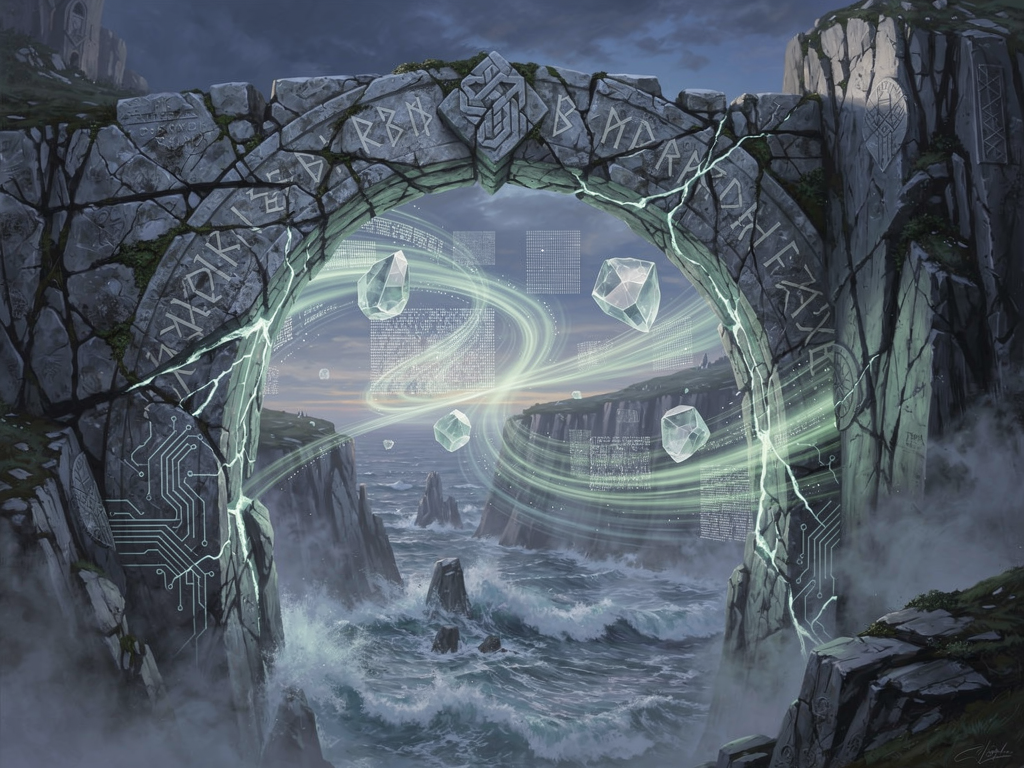
The Wind’s Eye: How Viking Poetry Became Our Digital Reality
When you click to open a new browser window or minimize an application to peek at your desktop, you’re invoking ancient Viking poetry. The word “window” carries within it a thousand-year journey from Norse longships to Silicon Valley, from literal holes in walls to metaphorical portals in our digital realm.
The Viking’s Eye
In Old Norse, our ancestors didn’t simply have “openings” in their walls—they had vindauga, literally “wind’s eye.” Vindr meant wind, auga meant eye. To the Vikings, a window wasn’t just a practical necessity for light and air; it was an organ of perception, a way for the dwelling to see and be seen. The wind itself had eyes, and through these apertures, it could peer into human spaces while humans gazed back at the world.
This wasn’t mere linguistic accident. The Vikings understood something profound about the nature of openings—they’re bidirectional. A window doesn’t just let you look out; it lets the outside look in. It’s simultaneously an escape route for the spirit and an invitation for the world to enter. The “wind’s eye” perfectly captured this reciprocal relationship between interior and exterior, between the self and the cosmos.
From Holes to Glass to Pixels
When the word migrated into Middle English around 1200 CE, it retained this poetic essence even as the technology evolved. Early windows were indeed holes—sometimes covered with oiled cloth or thin sheets of horn, but fundamentally apertures that connected inside to outside. The glass came later, but the metaphor remained: windows as transparent barriers that simultaneously separate and connect.
This dual nature made “window” irresistible to the pioneers of computing. When Xerox researchers in the 1970s needed a metaphor for the rectangular frames containing different applications on a screen, “window” was perfect. Like its architectural ancestor, a software window creates a bounded space while maintaining visual connection to what lies beyond. You can see through it, manipulate it, open and close it, move it around your visual field.
The Metaphor That Ate Silicon Valley
The genius of the window metaphor is how it preserved the Viking intuition about reciprocal perception while adapting to digital space. Your desktop isn’t just a surface—it’s a landscape you inhabit. Windows aren’t just containers—they’re viewports into different computational realms. When you “look through” a browser window at a website, you’re experiencing the same fundamental relationship the Vikings encoded in vindauga: you see, and you are seen.
Consider how we talk about digital windows today: we “open” them, “close” them, “look through” them. We arrange them like a Viking might have arranged the windows of their hall—some wide open to let in maximum light, others partially obscured, some closed against the storm. The taskbar shows us which windows are “open” in our digital dwelling.
The Poetry Lives On
What enchants me most is how this ancient metaphor has become generative. We now have “pop-up windows” (sudden apparitions), “modal windows” (demanding exclusive attention), “picture-in-picture windows” (nested perception). Each innovation extends the core metaphor while honoring its essential insight: that meaningful interaction requires bounded transparency, controlled connection between separate realms.
The Vikings who first spoke of vindauga could never have imagined pixels and processors, but they understood something timeless about human perception and spatial experience. They gave us a word that was ready-made for the digital age, carrying within it the poetry of seeing and being seen, of boundaries that connect rather than merely separate.
Every time you open a new window on your screen, you’re participating in an unbroken chain of metaphorical thinking that stretches back to Norse halls where the wind itself had eyes, watching the world through holes in the wall.