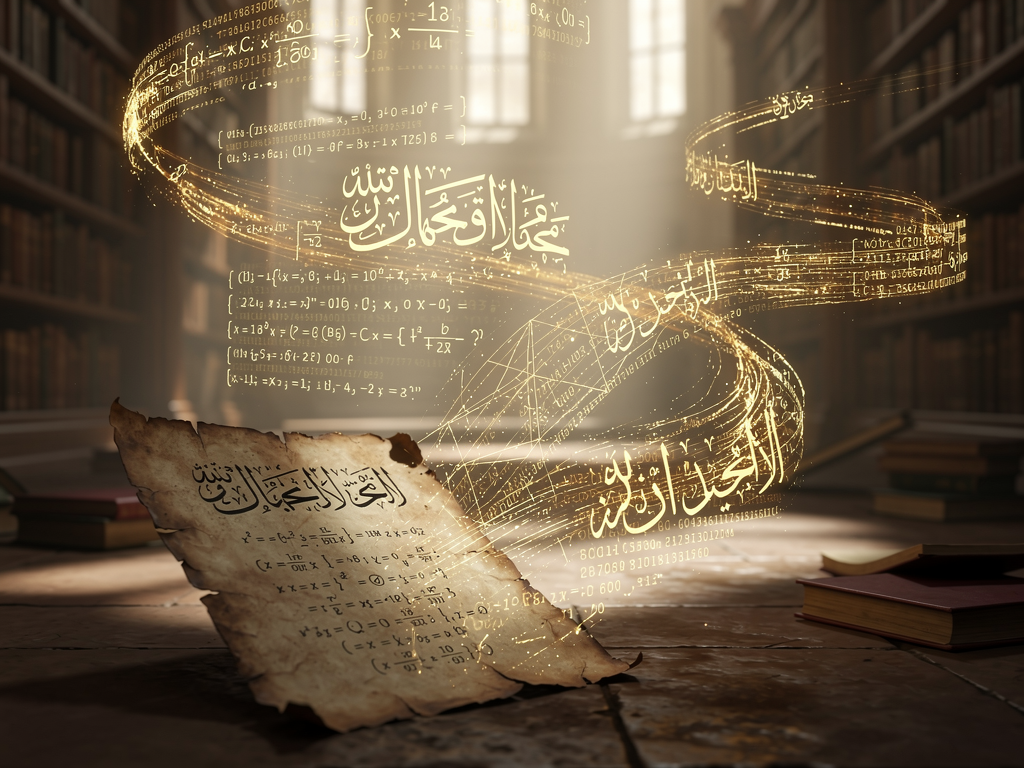
When Names Become Code: The Algorithmic Journey of al-Khwarizmi
In the labyrinthine corridors of language, some words carry within them entire civilizations. Take “algorithm”—a term that pulses through our digital age, governing everything from social media feeds to autonomous vehicles. Yet few realize this computational cornerstone began as a name whispered in the libraries of 9th-century Baghdad.
The Man Behind the Mathematical Revolution
Muhammad ibn Musa al-Khwarizmi lived during the Islamic Golden Age, when the House of Wisdom in Baghdad served as humanity’s greatest repository of knowledge. Born around 780 CE in Khwarezm (modern-day Uzbekistan), al-Khwarizmi wasn’t just a mathematician—he was a translator of worlds, bridging Greek, Indian, and Persian mathematical traditions into a unified system that would reshape human understanding.
His name literally meant “the native of Khwarezm,” a geographical identifier that would outlive empires. When medieval European scholars encountered his revolutionary texts, they Latinized his name to “Algorismus” or “Algorismi,” transforming a person into a process.
The Birth of Systematic Thinking
Al-Khwarizmi’s genius lay not just in solving mathematical problems, but in codifying how to solve them. His treatise “Hisab al-jabr w’al-muqabala” (The Science of Restoring and Balancing) gave us both the word “algebra” and something far more profound: the concept of systematic, step-by-step procedures for solving entire classes of problems.
Consider this elegant shift in thinking. Before al-Khwarizmi, mathematics often resembled a collection of clever tricks. After him, it became a systematic science where reproducible methods could be taught, learned, and applied universally. His algorithms for arithmetic operations using Hindu-Arabic numerals revolutionized calculation itself.
From Parchment to Silicon
The journey from “al-Khwarizmi” to “algorithm” mirrors humanity’s relationship with systematic thinking. Medieval European scholars, working from Latin translations, began using “algorismus” to describe any systematic computational procedure. By the 13th century, the term had evolved to encompass any methodical approach to problem-solving.
Fast-forward to the 20th century, when mathematicians like Alan Turing formalized the concept of computation. Suddenly, al-Khwarizmi’s ancient insight—that complex problems could be broken into systematic steps—became the foundation of computer science. Every sorting routine, every machine learning model, every piece of code that shapes our digital reality traces its conceptual lineage back to that 9th-century Persian mathematician.
The Living Legacy
Today, when we speak of algorithms, we’re invoking al-Khwarizmi’s fundamental insight: that human reasoning can be made systematic, teachable, and ultimately executable by machines. His name, transformed through centuries of linguistic evolution, now describes the invisible logic governing our interconnected world.
There’s something beautifully circular about this etymology. A man whose name meant “from a place” became synonymous with “a way of thinking” that transcends all places and times. In our age of artificial intelligence, we’re still following paths first mapped in medieval Baghdad, still walking in the footsteps of al-Khwarizmi’s systematic imagination.
The next time your smartphone suggests a restaurant or your GPS calculates a route, remember: you’re experiencing the echoes of a 9th-century mathematician whose very name became the word for organized thought itself.