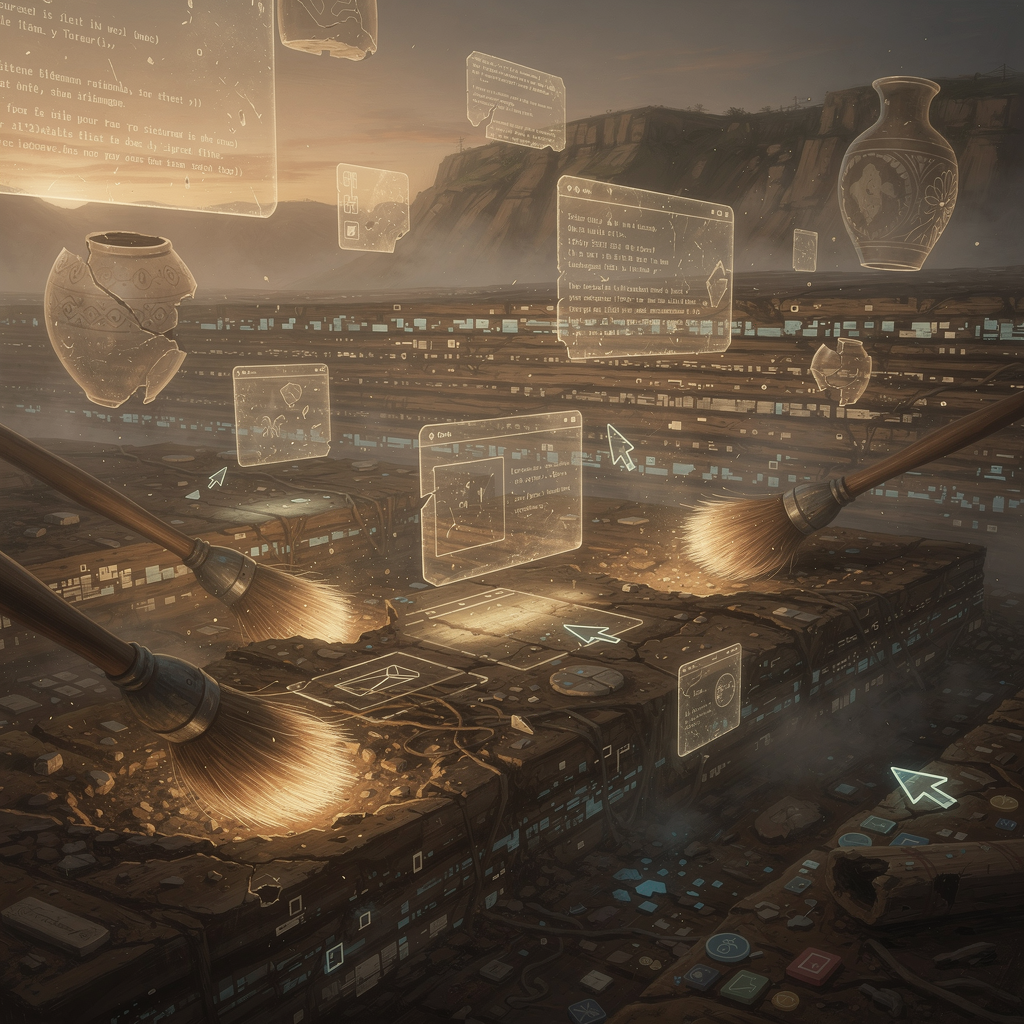
The Archaeology of Digital Shadows: Ghosts in the Machine
Every click leaves a trace. Every swipe creates a record. Every digital interaction casts a shadow that persists long after we’ve moved on, forgotten, or even died. In our hyperconnected age, we are all inadvertent archaeologists, constantly laying down sedimentary layers of data that future digital excavators might one day unearth and puzzle over.
But unlike the pottery shards and bone fragments that traditional archaeologists carefully brush from ancient soil, our digital artifacts exist in a liminal space—simultaneously everywhere and nowhere, preserved yet ephemeral, meaningful yet cryptic.
The Invisible Sediment of Our Lives
Consider the metadata that accumulates around a single photograph on your phone. Beyond the visible image lies a hidden archaeology: GPS coordinates pinpointing exactly where you stood, timestamp data precise to the second, camera settings that reveal the lighting conditions, even the orientation of your device. This invisible sediment tells stories we never intended to preserve.
When we send an email, we think we’re transmitting words. But we’re actually creating a complex archaeological artifact embedded with routing information, server timestamps, device fingerprints, and protocol handshakes. Each digital action generates what researchers call “data ghosts”—spectral traces of our presence that haunt databases and servers across the internet.
The Fragility of Digital Memory
The paradox of our digital age is that while we create more records than any civilization in history, these records are simultaneously more fragile than clay tablets buried in Mesopotamian ruins. Unlike linear historical records that decay predictably over millennia, digital artifacts face unique vulnerabilities.
Websites emerge, evolve, and vanish, leaving only shadows of their existence. File formats become obsolete. Servers go offline. Cloud services shut down. The very platforms we trust with our digital lives operate under terms of service that can change overnight, transforming our carefully curated digital selves into digital ghosts.
Museums and libraries worldwide now grapple with preserving cultural heritage in formats that might be unreadable in decades. A medieval manuscript can survive a thousand years if properly stored, but will a JPEG file from 2024 be accessible in 2124? The question haunts digital archivists who understand that preservation requires not just storage, but continuous migration, emulation, and vigilant maintenance.
Archaeological Layers in Code
Software itself creates archaeological layers. Every update, every patch, every deprecated function leaves traces in version control systems. Code comments become ancient inscriptions, revealing the thoughts and frustrations of programmers who may have moved on years ago. Error logs accumulate like refuse heaps, telling stories of digital civilizations struggling with bugs and system failures.
In this context, programmers become unwitting scribes of digital civilization, and their GitHub repositories transform into archaeological sites where future digital archaeologists might reconstruct not just what we built, but how we thought about building it.
The Ethics of Digital Excavation
This raises profound questions about consent and privacy. Traditional archaeology deals with the long-dead, but digital archaeology often excavates the traces of the living. When researchers visualize “data ghosts” or analyze the shadows we cast in metadata, whose stories are they telling? Who has the right to excavate our digital remains?
The ghosts we leave in metadata are not just technical artifacts—they are fragments of human experience, inadvertently preserved in the amber of databases and server logs. They deserve the same careful, respectful treatment that archaeologists bring to ancient burial sites.
Living Among Our Digital Shadows
As we navigate this strange new world where our shadows persist long after we’ve passed, perhaps we need new rituals, new awareness, new digital hygiene practices. We are the first generation to live knowing that our ghosts will be made of metadata, our afterlives archived in databases we’ll never see.
The archaeology of our digital shadows is still being written. Every day, we add new layers to the sediment of human experience, creating the ruins that future digital archaeologists will excavate with tools we can’t yet imagine. In this light, every status update becomes a cave painting, every search query a prayer inscribed on digital stone.