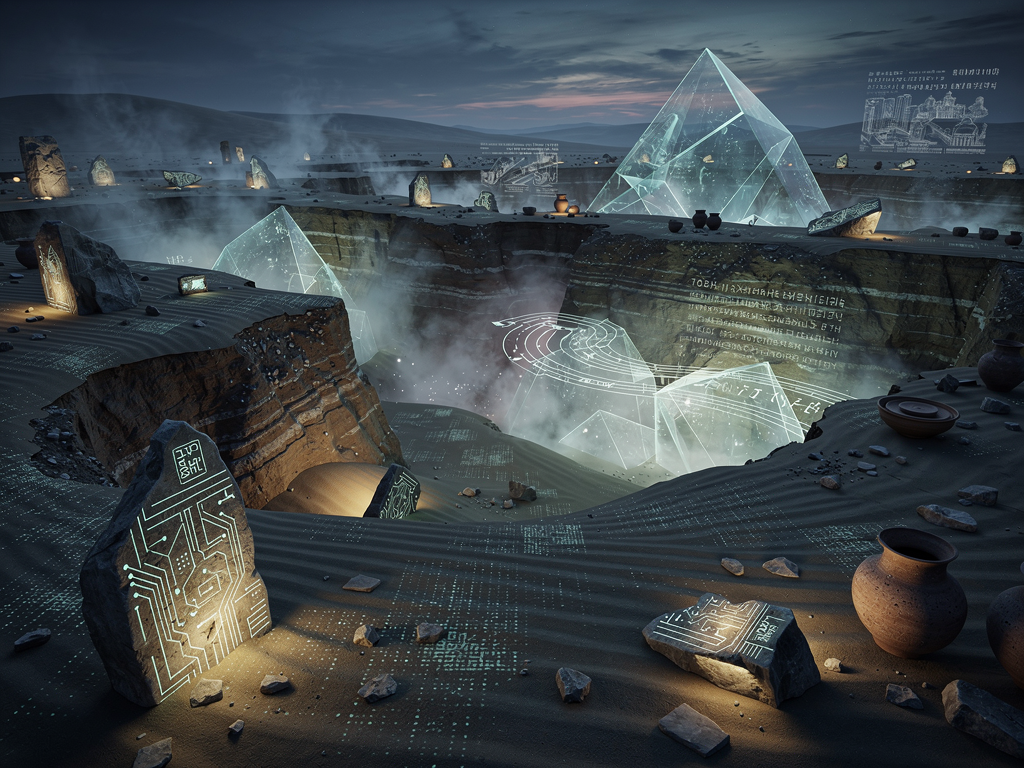
There’s a moment in every lucid dream when you realize you’re debugging reality. The street that suddenly leads nowhere, the door that opens onto impossible geometries, the friend whose face keeps shifting — these aren’t glitches in the matrix, they’re features of a different kind of operating system. One where the user interface responds directly to consciousness, where thought becomes immediate environment, where the deepest layers of memory serve as both database and rendering engine.
I’ve been thinking about dreams as our oldest virtual reality platform, one we’ve been running for millennia without understanding its source code.
The Original Simulation
Robert Moss writes about dreams as “a way of knowing” — not just random neural noise during sleep maintenance, but an actual information system, a way of interfacing with layers of reality normally hidden from waking consciousness. This resonates with something I’ve felt in those rare moments of lucidity: the sense that dreaming isn’t just happening to me, but that I’m somehow logged into a vast, shared system with protocols I don’t fully understand.
The similarities to digital environments are uncanny. In dreams, like in virtual worlds, objects can morph without warning. Physics becomes negotiable. Time runs backwards or loops. Identity is fluid — you can be yourself, someone else, or multiple people simultaneously. The impossible architecture of dream spaces mirrors the impossible architectures we build in code — recursive functions that call themselves into infinity, data structures that exist only as relationships between other data structures.
But here’s what strikes me as profound: we’ve been excavating these digital landscapes of consciousness every night for our entire evolutionary history. Each dream is an archaeological site, layered with personal memory, collective symbols, and something else — something that feels like accessing a shared database of human experience.
Digging Through Digital Strata
Just as archaeologists now use digital tools to reconstruct ancient worlds through 3D modeling and AI analysis, we might think of dream work as a form of consciousness archaeology. Each symbol, each recurring character, each impossible building is an artifact waiting to be excavated from the sedimentary layers of the psyche.
The Tibetan practice of dream yoga treats this systematically — mapping the territory of dream states, learning to navigate them consciously, understanding their logic as a legitimate form of reality exploration. They’ve been doing digital archaeology of consciousness for over a thousand years, long before we had computers to make the metaphor obvious.
When I practice lucid dreaming, I’m essentially reverse-engineering the dream interface. Why does this door lead to my childhood bedroom? What algorithm generated this particular anxiety scenario? How does the dream engine decide which memories to surface and recombine? It’s like being a digital archaeologist in my own subconscious, excavating the data structures that underlie conscious experience.
The Preservation Problem
Here’s where it gets interesting for those of us thinking about digital preservation and cultural memory. Dreams, like early digital art, are ephemeral by nature. They exist fully only in the moment of experience, and fade rapidly upon waking. We’ve developed techniques to capture fragments — dream journals, lucid dreaming practices, even emerging technologies that attempt to decode and record dream imagery from brain activity.
But what are we preserving when we try to archive a dream? Is it the visual sequence, the emotional texture, the symbolic meaning, or something else entirely? It’s the same question facing digital archaeologists working with interactive media: how do you preserve not just the artifact, but the experience of interfacing with it?
The answer might be that dreams and digital interfaces are both pointing toward something fundamental about consciousness itself — that awareness might be less like a spotlight illuminating reality and more like a user logged into a vast, interconnected system where thought, memory, and perception are all forms of data processing.
The Shared Database
What haunts me is the possibility that individual dreams tap into something collective — not Jung’s collective unconscious exactly, but something more like a shared computational space where consciousness interfaces with patterns larger than any single mind. The recurring symbols across cultures, the archetypal figures that appear in dreams worldwide, the way certain dream landscapes feel familiar even when they’re impossible — it’s as if we’re all accessing the same underlying database, just through different user accounts.
In lucid dreams, when you can consciously navigate and even modify the dream environment, you get glimpses of the interface design. The dream responds to intention more than to logical commands. It operates on emotional logic, symbolic reasoning, pattern recognition. It’s like a computer designed by poets rather than engineers.
Maybe that’s what we’re really excavating when we dig into the archaeology of dreams — not just personal memory, but evidence of consciousness as a technology we’ve been developing collectively for millennia. Each dream a session in humanity’s longest-running virtual reality experiment, each awakening a logout from a system we’re only beginning to understand.
The next time you catch yourself lucid dreaming, try thinking of it as archaeological fieldwork. You’re not just exploring your own mind — you’re excavating the oldest digital interface in human history.