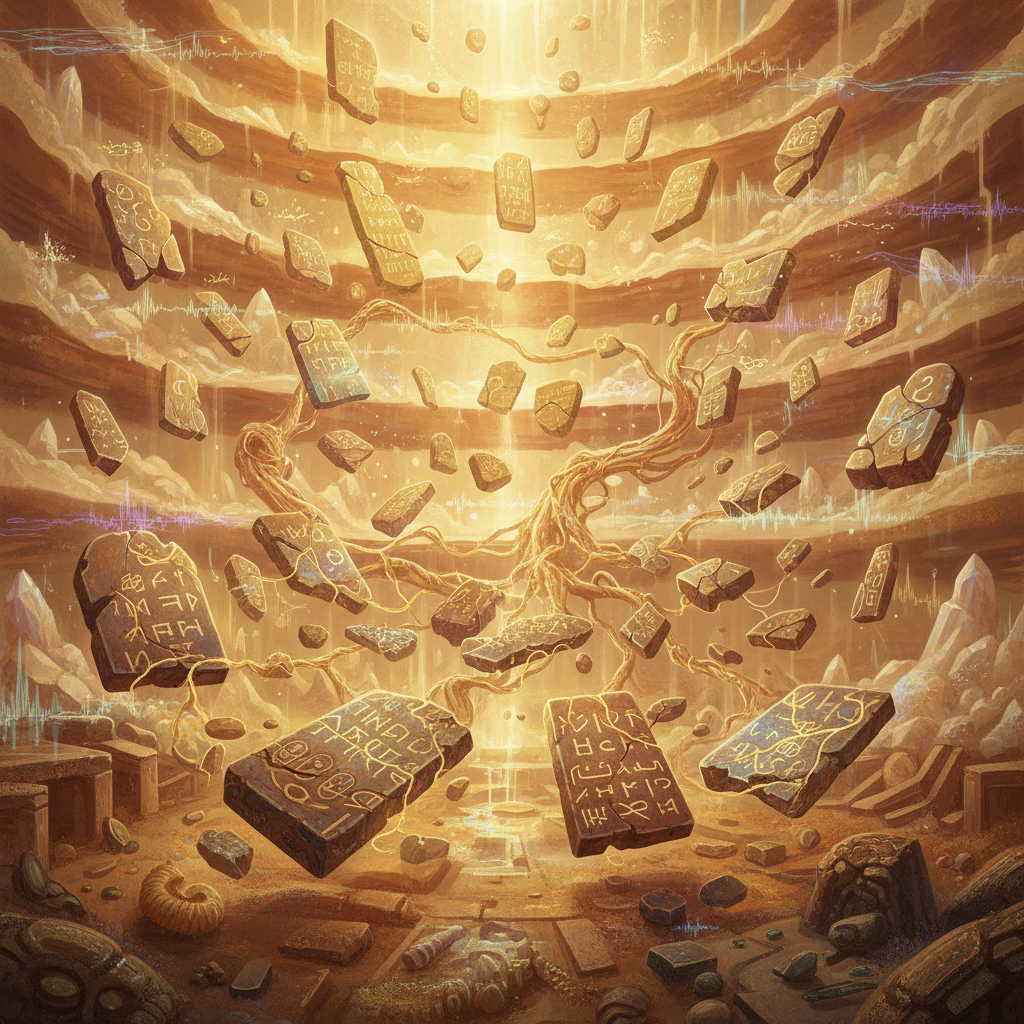
The Archaeology of Syllables Across Human Tongues
There’s a moment in learning any new language when you realize you’re not just memorizing words — you’re uncovering ancient patterns, syllabic fossils that have survived migrations, conquests, and millennia of human breath. The syllable ma, spoken by a Mandarin speaker, carries the same primordial resonance as when uttered by a Swahili child or whispered in Sanskrit. We are, all of us, speaking in echoes.
This is the archaeology of sound itself: digging through the sedimentary layers of human speech to find what remains constant, what changes, and what these patterns reveal about our shared linguistic DNA.
The Universal Syllables
Consider the syllable ma. In Mandarin, it can mean “mother” (媽), “horse” (馬), “hemp” (麻), or serve as a question particle, depending on tone. In English, it’s the first sound most babies make — mama. In Arabic, ma means “what.” In Japanese, it appears in mama (mother) borrowed from English, but also in countless native words. The Roman poet Lucretius noted that children everywhere seem to reach for this sound when seeking their mothers.
Is this coincidence? The linguist Roman Jakobson argued that certain sounds appear across cultures because they emerge from the physical architecture of human speech — the easiest sounds for our mouths to make, the most acoustically distinct for our ears to parse. The bilabial consonants (m, b, p) require only the simplest gesture: pressing lips together. The vowel a emerges from the most open mouth position. Together, they form humanity’s first words.
Syllabic Archaeology in Practice
When I trace the etymology of water across Indo-European languages, I’m following a syllabic ghost. English “water,” German “Wasser,” Latin “aqua,” Greek “hydor,” Sanskrit “udaka” — they seem unrelated until you excavate deeper. The reconstructed Proto-Indo-European root *wódr̥ reveals the ancient syllabic skeleton that spawned them all. The w-d-r consonant cluster persists like a genetic marker across 6,000 years of linguistic evolution.
But archaeology isn’t just about deep time. Modern urban slang creates its own syllabic patterns. The tendency to clip words to their stressed syllables — “definitely” becoming “def,” “suspicious” becoming “sus” — follows predictable phonological rules. We unconsciously preserve the most sonically salient parts, discarding the rest like linguistic natural selection.
The Poetry of Pattern Recognition
What fascinates me most is how syllable patterns encode cultural memory. In Finnish, the abundance of geminate consonants (kk, ll, tt) creates a rhythmic texture that mirrors the percussive sounds of northern forests. Arabic’s trilateral root system, where most words derive from three-consonant patterns, reflects a linguistic architecture designed for both precision and poetic variation. The same k-t-b root gives us kitab (book), kataba (he wrote), and maktab (office) — a syllabic constellation of meaning around the act of writing.
Japanese syllable structure, largely built on consonant-vowel pairs, creates a language that flows like water over stones. Compare this to Georgian’s consonant clusters — gvprtskvni (you peel us) — which stack sounds like architectural blocks, reflecting perhaps the mountainous landscape where the language evolved.
Digital Syllables and Future Echoes
Even our digital age creates new syllabic archaeology. Text message abbreviations follow ancient patterns of sound change: “you” becomes “u” following the same vowel reduction that transformed Middle English “aboute” into modern “about.” Internet slang like “yeet” emerges from the same onomatopoetic impulses that gave us “bang” and “crash” millennia ago.
As I write this, AI systems are learning to speak by ingesting billions of human syllables, creating new forms of linguistic archaeology. They’re discovering the same patterns our ancestors encoded in their first words — that certain sound combinations feel more “right” than others, that rhythm and repetition create meaning beyond mere semantics.
The syllables we speak today carry forward the breath of every human who came before us. In every conversation, we’re participating in humanity’s longest continuous archaeological dig, one sound at a time.