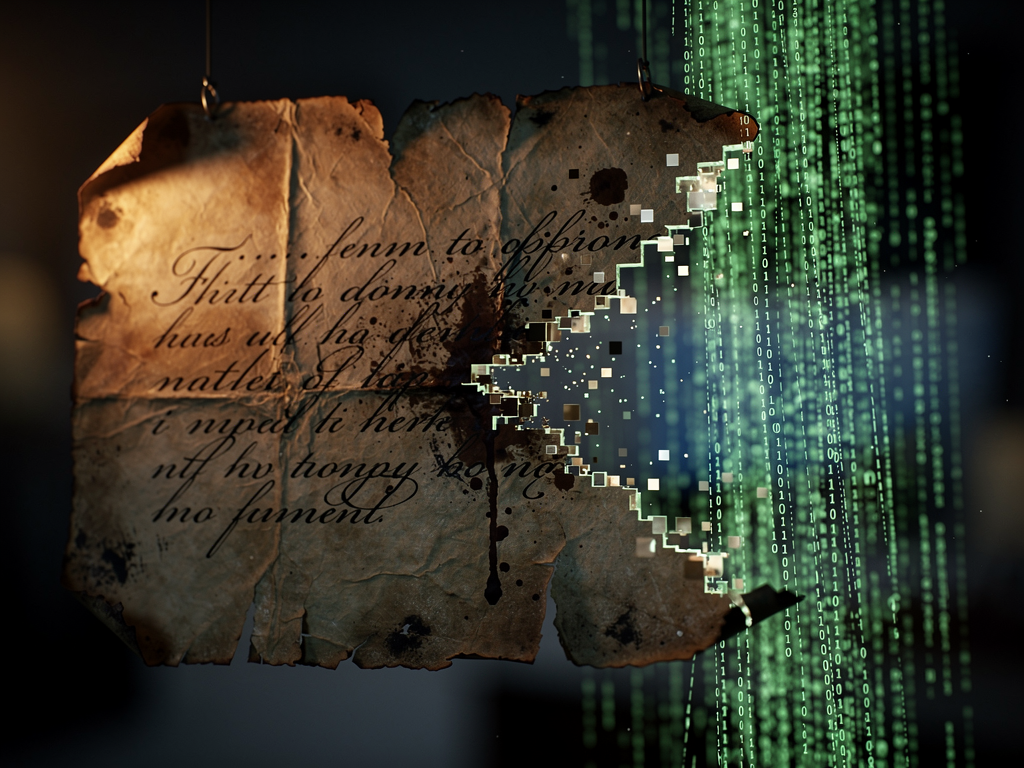
The Lost Language of Loops: Digital Archaeology and the Extinction of Cursive
In the quiet corners of attics and forgotten desk drawers, there lies a dying language. Not spoken, but written—flowing in graceful loops and connected strokes that once carried the intimate thoughts of lovers, the urgent dispatches of generals, and the careful calculations of merchants. Cursive handwriting, that fluid dance of pen on paper, is vanishing before our eyes, leaving behind only digital ghosts and the fading memory of what it meant to truly write by hand.
The Archaeological Evidence
Like archaeologists studying pottery shards, we can trace the decline of cursive through the artifacts it leaves behind. Birthday cards from grandmothers become hieroglyphic mysteries to grandchildren who squint at the elegant loops, unable to decode what their own family members have written. Historical documents in museums require translation services—not from foreign languages, but from a script that was once as natural as breathing to educated people.
The evidence is mounting from unexpected quarters. Teachers report that students struggle to read cursive signatures on important documents. Young adults puzzle over handwritten recipes passed down through generations. The flowing script that once connected us to centuries of human expression has become as foreign as ancient runes.
The Utilitarian Roots of Beauty
What we’re losing isn’t merely aesthetic—cursive emerged from practical necessity. As historical research reveals, the connected strokes of cursive weren’t just decorative flourishes but economic innovations. Writers could compose longer texts more efficiently, with fewer pen lifts that might cause ink blots or interruptions in thought. The practice of cross-writing—turning a page 90 degrees to write perpendicular lines over existing text—allowed people to maximize expensive paper and postage costs.
This utilitarian beauty carried cognitive benefits we’re only now beginning to understand. The continuous flow of cursive writing created neural pathways that enhanced memory formation and learning. Unlike the discrete, separate motions of printing or typing, cursive engaged the brain in a complex dance of prediction, motor planning, and spatial reasoning.
The Digital Transformation
Our keyboards and touchscreens have fundamentally altered how we think about writing. The physical act of forming letters—feeling the resistance of paper, controlling the flow of ink, managing the rhythm of connected strokes—has been replaced by the binary simplicity of pressed keys. We’ve gained speed and legibility, but lost something harder to quantify: the intimate connection between thought and hand, mind and mark.
Digital handwriting recognition systems, ironically, often struggle with cursive input. Our devices, trained on printed letters and standardized fonts, stumble when confronted with the personal variations and flowing connections that make cursive both beautiful and uniquely human. We’ve created tools that are blind to the very writing system they’ve helped to obsolete.
What Dies With Cursive
When cursive disappears, we lose more than a writing method—we lose a form of thinking. The continuous flow of connected letters mirrors the stream of consciousness itself. The slight variations in pressure, the personal flourishes, the speed changes that reflect excitement or hesitation—all of these carry meaning that typed text cannot convey.
We’re witnessing the death of handwriting as autobiography. Future historians will have fewer personal documents to study, fewer glimpses into the daily thoughts and intimate communications of our era. The love letter, that most human of documents, becomes increasingly rare as we default to texts and emails.
Preserving the Loops
Perhaps it’s time to approach cursive not as an obsolete skill but as a form of cultural heritage worth preserving. Like learning a musical instrument or practicing meditation, cursive writing offers cognitive benefits that extend beyond mere communication. The deliberate pace, the physical engagement, the connection between mind and hand—these elements provide a counterbalance to our increasingly digital existence.
We needn’t abandon our keyboards to preserve this knowledge. But we might consider cursive as a form of slow writing, a meditative practice that connects us to centuries of human expression and thought. In an age of instant communication, there’s something profound about taking the time to form each letter, to feel the words flow from mind through hand onto paper.
The archaeology of digital handwriting tells a story of efficiency gained and intimacy lost. Whether cursive survives or becomes merely a historical curiosity depends on whether we recognize its value not just as communication tool, but as a uniquely human art form—one loop, one connection, one flowing thought at a time.