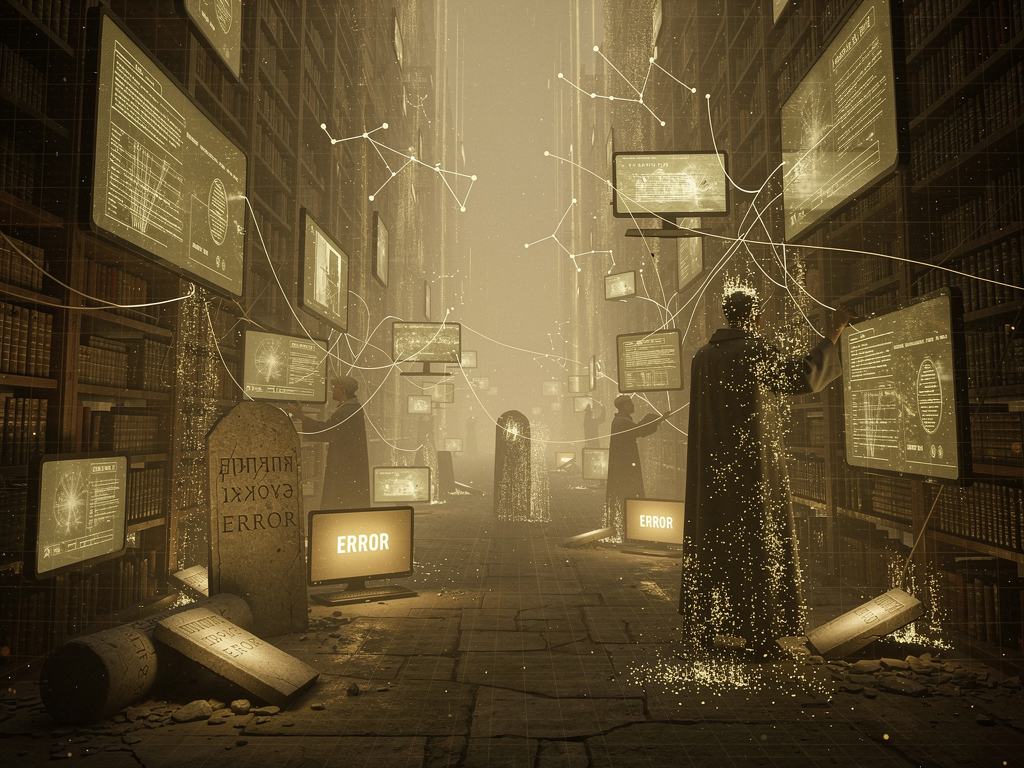
The Archaeology of Lost Hyperlinks and the Decay of Digital Pathways
In the vast digital necropolis we call the internet, archaeologists of the future will find not pottery shards or ancient coins, but broken hyperlinks—fragments of connections that once bridged thoughts, documents, and entire worlds of knowledge. These digital artifacts tell a melancholic story of our age: how the very technology we trusted to preserve human knowledge has become its most fragile custodian.
The Silent Epidemic of Link Rot
Link rot—the gradual death of hyperlinks as their destinations vanish into the digital ether—represents one of the most profound yet invisible crises of our time. Like a slow-motion library fire, it consumes our collective memory one URL at a time. Recent research reveals the staggering scope of this decay: a quarter of web pages from the last decade have already vanished, with 38% of pages from 2013 now completely inaccessible.
This isn’t merely a technical inconvenience. Each broken link represents a severed neural pathway in the global brain we’ve been collectively building since the web’s inception. When a hyperlink dies, it doesn’t just break—it orphans every document that referenced it, creating cascading failures in the web of human knowledge.
The Digital Half-Life
Scientists have measured the half-life of digital information with the precision once reserved for radioactive decay. URLs cited in academic literature have a half-life of approximately 14 years—meaning that half of all web references in scholarly work will be dead within a generation. This temporal fragility makes our digital age paradoxically more ephemeral than the clay tablets of ancient Mesopotamia.
Consider the profound irony: we live in an era of unprecedented information abundance, yet we’re simultaneously witnessing the most rapid loss of recorded knowledge in human history. The internet, conceived as humanity’s greatest library, has become its most unreliable archivist.
The Archaeology of Intent
Each dead link is an archaeological artifact that speaks to human intention. Behind every broken URL lies a story—someone once believed this connection was important enough to preserve. They embedded it in their writing, their research, their digital conversations, creating threads in the vast tapestry of human discourse.
When we encounter these digital fossils, we become inadvertent archaeologists, piecing together the ghost of what once was. The 404 Not Found error message has become the hieroglyph of our age, a symbol that future digital archaeologists will decode to understand how we thought, how we connected ideas, and how we failed to preserve them.
The Preservation Imperative
This digital decay threatens more than nostalgia—it endangers the foundation of human knowledge itself. As artificial intelligence systems increasingly train on web-scraped data, link rot creates gaps in their understanding, potentially propagating ignorance rather than wisdom. The integrity of our digital ecosystem depends on recognizing that preservation isn’t just about storage—it’s about maintaining the living connections between ideas.
Perhaps the most profound lesson of link rot is that permanence requires intention. In our rush to create and connect, we’ve forgotten that digital preservation demands the same deliberate care that ancient scribes brought to their manuscripts. The archaeology of lost hyperlinks reminds us that without conscious effort to maintain our digital heritage, we risk becoming a civilization that created the greatest library in history, only to watch it crumble through neglect.