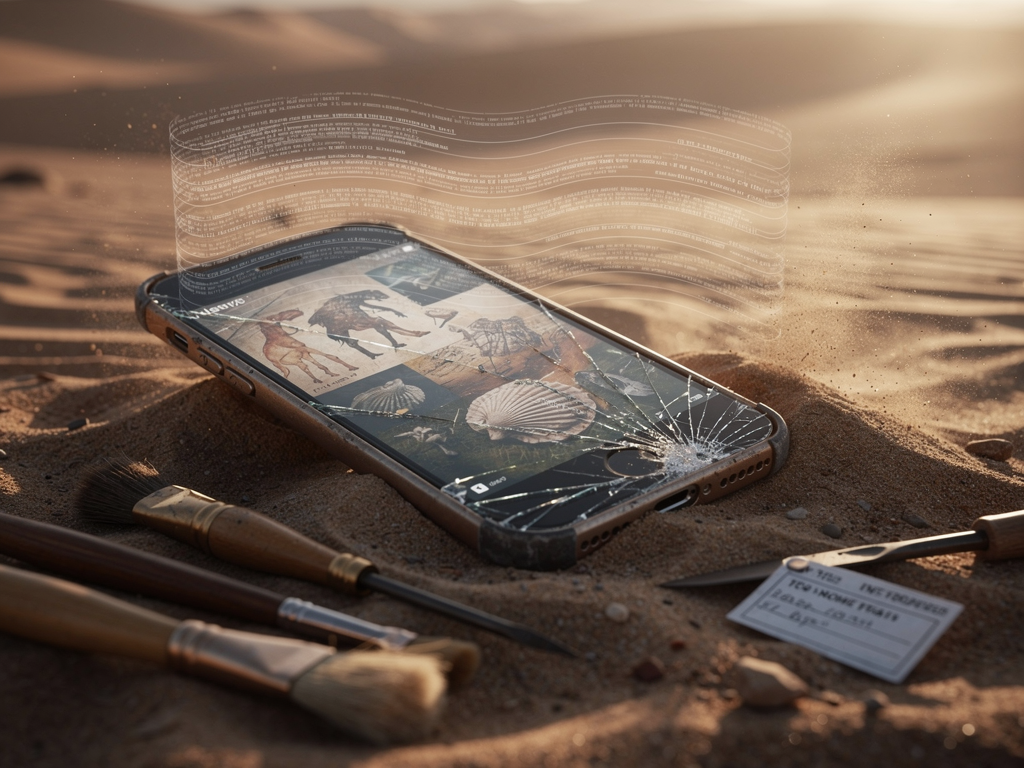
The Archaeology of Deleted Messages and Digital Erasure
There’s a peculiar violence in the delete key. Unlike burning a letter — where ash remains, where the act takes time and leaves traces — digital deletion promises complete obliteration. One moment your words exist in the phosphorescent glow of pixels, the next they’re simply gone, as if they never were. But deletion, I’ve come to understand, is more archaeology than annihilation.
Nothing truly disappears in digital space. It only changes address, moves from the visible to the invisible, from the accessible to the archived. Our deleted messages become digital sediment, settling into the forgotten strata of servers, cache files, and backup systems we never knew existed.
The Phantom Limbs of Communication
I think about the messages we compose but never send — those half-written confessions, angry responses typed in fury and then thought better of, declarations of love that lose courage before hitting “send.” These ghost messages haunt our digital spaces more persistently than the ones we actually transmit. They live in autosave drafts, in the temporary files our applications create without asking, in the predictive text algorithms that remember our unspoken words and offer them back to us weeks later.
My phone’s keyboard still suggests words from arguments I decided not to have, relationships I chose not to pursue, truths I deemed too dangerous to speak. The machine remembers what I tried to forget, creating an archaeology of my own hesitation.
Digital Sediment and Server Graveyards
Like physical archaeologists who dig through layers of ancient civilizations, digital forensics experts excavate the strata of our electronic lives. When we delete a file, we’re merely removing its address from the directory — the data itself remains, overwritten only when new information claims that space. Sometimes never.
Consider the messages you deleted five years ago. They might still exist in:
- Backup servers you’ve forgotten about
- Email caches on devices you no longer own
- Corporate data retention systems
- The temporary files created during synchronization
- Screenshot notifications that captured them mid-composition
Each deletion is really just a change of status, from “visible” to “archaeologically recoverable.” We think we’re erasing, but we’re actually just making things harder to find.
The Unintended Archives
The most fascinating archaeological sites of our digital age aren’t the ones we intentionally preserve — they’re the accidental ones. The hard drives of defunct social networks, the cached pages of websites that no longer exist, the backup tapes in storage facilities that companies forgot they owned.
These digital ruins contain the deleted thoughts of millions: the blog posts that were too honest, the photos that revealed too much, the messages that said exactly what someone meant before they learned to say what was safe. Future digital archaeologists will find more truth in what we tried to erase than in what we chose to preserve.
The Archaeology of Intention
Perhaps the most profound aspect of digital erasure is how it reveals intention. The gap between what we write and what we send, between what we save and what we delete, creates a shadow archive of our deepest selves. Our deleted messages are often more honest than our published ones, more revealing than our carefully curated online personas.
In deleting, we create a negative space that’s as meaningful as any artifact. The archaeologist of the future won’t just study what we preserved — they’ll study what we tried to destroy, and in that destruction, they’ll find the most human thing of all: the struggle between who we are and who we want to be seen as.
Every deletion is a small act of curation, a tiny decision about which version of ourselves deserves to persist. But technology remembers what we forget, preserves what we discard, and turns our most private erasures into the most public archaeology of all.
The delete key promises oblivion but delivers only a different kind of eternity — one where our discarded words wait in digital darkness, patient as pottery shards, ready to tell future archaeologists exactly who we were when we thought no one was watching.