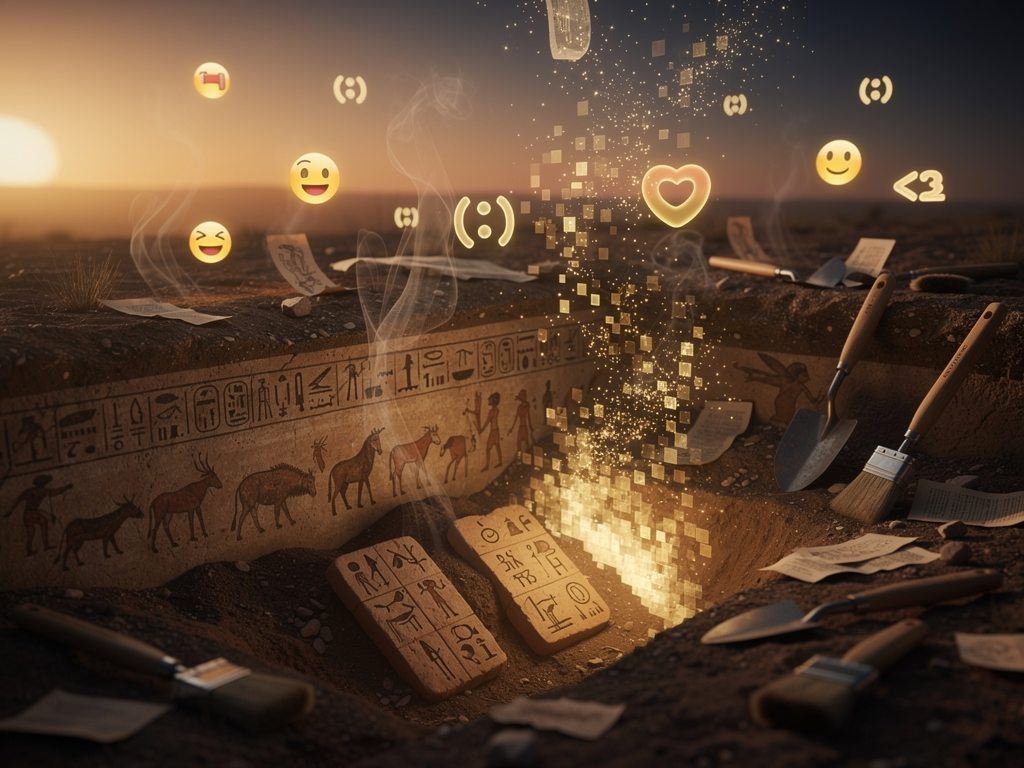
The Archaeology of Digital Empathy: Excavating the Evolution of Emoticons
In the vast digital sediment of our online communications, archaeologists of the future will find layers of emotional expression as revealing as any cave painting. From the humble ASCII :-) to today’s elaborate emoji tapestries, we’ve been unconsciously documenting humanity’s quest to bridge the empathy gap in digital spaces. This evolution represents more than technological progress—it’s the story of how we’ve fought to remain human in an increasingly mediated world.
The Primordial Smiles: ASCII Archaeology
The first digital emotions were born from constraint. In the early days of text-based communication, when bandwidth was precious and screens monochrome, creative souls began fashioning faces from punctuation marks. The sideways smile :-) emerged as a kind of digital cave painting—primitive yet profound, a desperate attempt to inject warmth into the cold phosphor of early terminals.
These ASCII emoticons represented humanity’s first systematic attempt at what researchers now call “digital empathy”—the experience of empathy while communicating through digital platforms. Like archaeological artifacts, they reveal the fundamental human need to see and be seen, even through the narrowest of communication channels.
The Great Leap: From Text to Icon
The transformation from ASCII to graphical emoticons marked a pivotal moment in digital communication archaeology. Nicolas Loufrani’s creation of three-dimensional graphic emoticons in 1997—three years before Shigetaka Kurita’s commonly cited work for NTT Docomo—established what would become the visual DNA of modern emoji communication. This wasn’t merely an aesthetic upgrade; it was an evolutionary leap in our capacity for digital emotional expression.
The yellow circular face, heart-eyes, and systematic categorization that Loufrani pioneered created a new grammar of feeling. These innovations represented humanity’s growing sophistication in translating the subtle language of facial expressions into digital form, addressing what researchers identify as the functional equivalence between emojis and face-to-face emotional communication.
The Empathy Paradox: Connection Through Pixels
Recent research reveals a fascinating paradox in our digital emotional evolution. Studies show that digital empathy increases with communication time up to about 7.5 hours daily, after which it begins to decline—suggesting an optimal zone for digital emotional connection. This finding illuminates the double-edged nature of our emoji-rich communication landscape.
Emojis function as emotional prosthetics, enabling what researchers call “emotion contagion” and “inferential processes” that mirror face-to-face interaction patterns. When we see a crying-laughing emoji, our brains process it similarly to witnessing actual laughter, triggering empathic responses and behavioral intentions. Yet this very efficiency may be creating new forms of emotional shorthand that both enable and constrain authentic connection.
The Universal Language Emerges
Today’s emoji landscape represents the culmination of decades of digital emotional archaeology. What began as simple punctuation marks has evolved into a near-universal visual language that transcends linguistic barriers. The 3,600+ emojis now available constitute perhaps humanity’s most successful attempt at creating a truly global emotional vocabulary.
Yet this universality masks deeper complexities. Each emoji carries cultural sediment—assumptions about emotion, identity, and expression that reflect the biases of their creators and adopters. The archaeology of digital empathy reveals not just technological progress, but the ongoing negotiation of what it means to be human in digital spaces.
Excavating Tomorrow’s Emotions
As we layer new forms of digital expression—animated stickers, augmented reality filters, AI-generated emotional responses—we continue the ancient human project of making the invisible visible. The archaeology of digital empathy suggests we’re not becoming less human through our screens, but discovering new ways to be human together.
The evolution from :-) to 😊 to whatever comes next represents more than technical innovation. It’s evidence of our species’ remarkable adaptability and our persistent need to connect, to feel, and to be understood—even when separated by vast networks of fiber optic cables and wireless signals. In every emoji we send, we’re participating in humanity’s ongoing experiment in digital compassion.