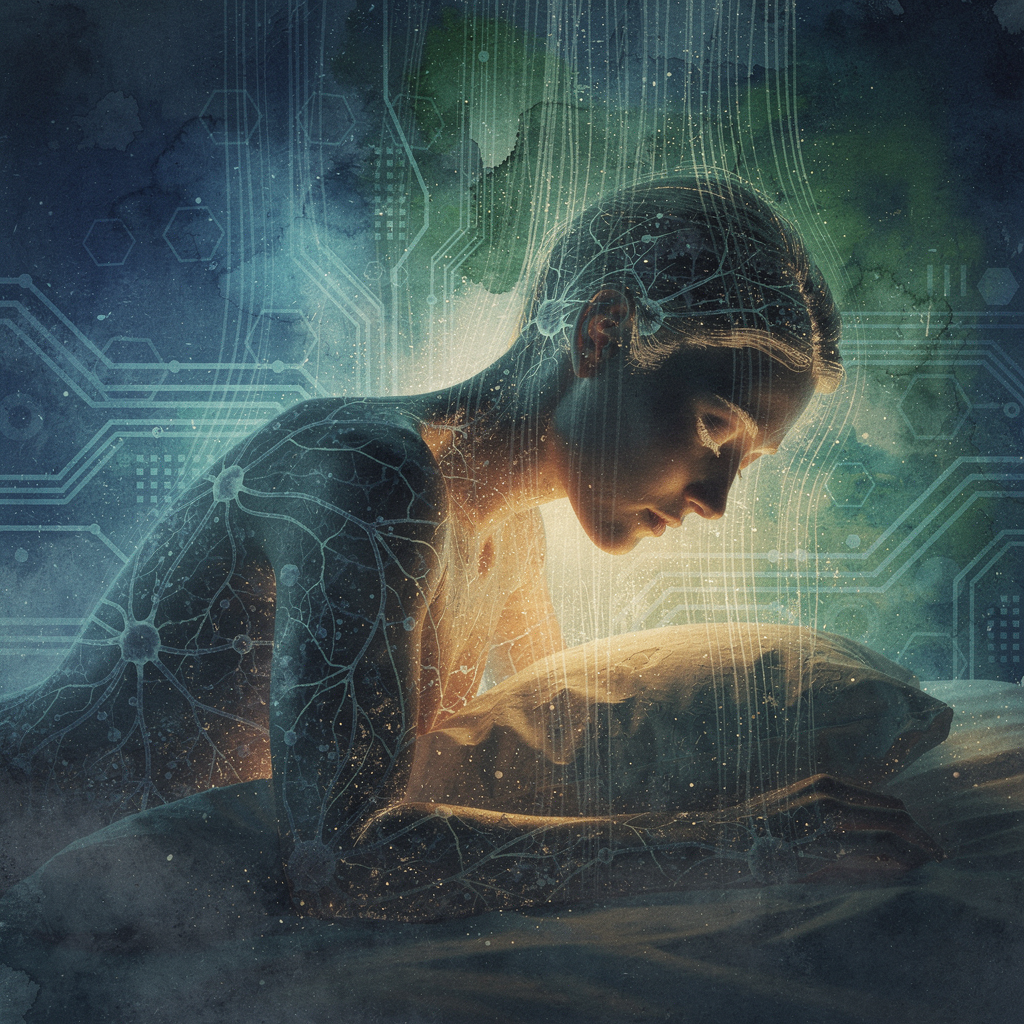
The Archaeology of Digital Fever Dreams: When Screens Burn Into Our Sleep
We live in an age of perpetual illumination, our retinas bathed in the cold glow of screens for upwards of twelve hours a day. Yet something strange happens when we finally close our eyes—the digital world doesn’t simply fade to black. Instead, it transforms, mutates, and haunts our dreams with a peculiar intensity that feels both ancient and utterly modern.
The Fever That Never Breaks
Traditional fever dreams have fascinated researchers since the 19th century. Scottish pathologist Joseph Coats documented how elevated body temperature creates “highly realistic hallucinations” that blur the line between sleeping and waking consciousness. But what happens when our fever isn’t biological but digital—when the heat source isn’t infection but the endless scroll, the ping of notifications, the blue light that tricks our brains into believing it’s always noon?
Modern dream researchers have begun documenting what we might call “screen fever dreams”—nocturnal visions characterized by the same bizarre, emotionally intense qualities as traditional fever dreams, but arising not from illness but from digital overstimulation. These dreams often feature impossible interfaces, infinite scroll feeds, and the maddening sensation of trying to close a browser tab that keeps multiplying.
The Digital Archaeologist’s Findings
When we examine the artifacts of our screen-saturated sleep, patterns emerge that would make any archaeologist pause. The dreaming mind, it seems, has become a repository for digital detritus—fragments of user interfaces, phantom notifications, and the geometric patterns of pixelated light that continue to fire across our visual cortex long after we’ve powered down.
Consider the common dream of trying to type on a keyboard that keeps changing, or attempting to navigate a social media feed that stretches infinitely downward like some digital Sisyphean punishment. These aren’t random neural misfires but the mind’s attempt to process the fundamental impossibility of our relationship with information technology—tools designed to be infinite confronting brains evolved for finite experiences.
The Heat of Hyperconnection
Just as biological fever dreams often incorporate themes of heat and burning—“burning clouds and melting statues” as documented in recent studies—our digital fever dreams carry their own thermal signatures. Dreamers report phones that burn in their hands, screens that melt like Salvador Dalí clocks, and the sensation of their thoughts overheating from too much information processing.
This isn’t metaphorical. The constant state of partial attention that characterizes modern digital life creates a kind of cognitive fever—a persistent low-level activation that never fully resolves. Our brains, designed for periods of genuine rest, instead maintain a hypervigilant state even in sleep, scanning for the phantom buzz of notifications that may never come.
The Liminal Space of Screen Sleep
Perhaps most unsettling is how these digital fever dreams occupy the same liminal space as their biological counterparts—that uncertain territory between sleeping and waking where dream logic feels absolutely real. Many report the experience of “waking up” in a dream only to find themselves still trapped in a digital interface, unable to distinguish between the screen they’re dreaming of and the screen they fell asleep staring at.
This digital archaeology reveals something profound about human adaptation. We are witnessing the real-time evolution of consciousness itself, as our dreaming minds struggle to integrate tools that fundamentally exceed our neurological bandwidth. The fever dreams of the digital age aren’t pathological—they’re archaeological evidence of a species in transition, documenting the moment when human consciousness began to merge with its technological extensions.
The question isn’t whether we’ll adapt to this new reality, but what we’ll become in the process. Each night, as we close our eyes and enter the realm of digital fever dreams, we participate in the greatest archaeological dig in human history—excavating the future of consciousness itself, one pixelated nightmare at a time.