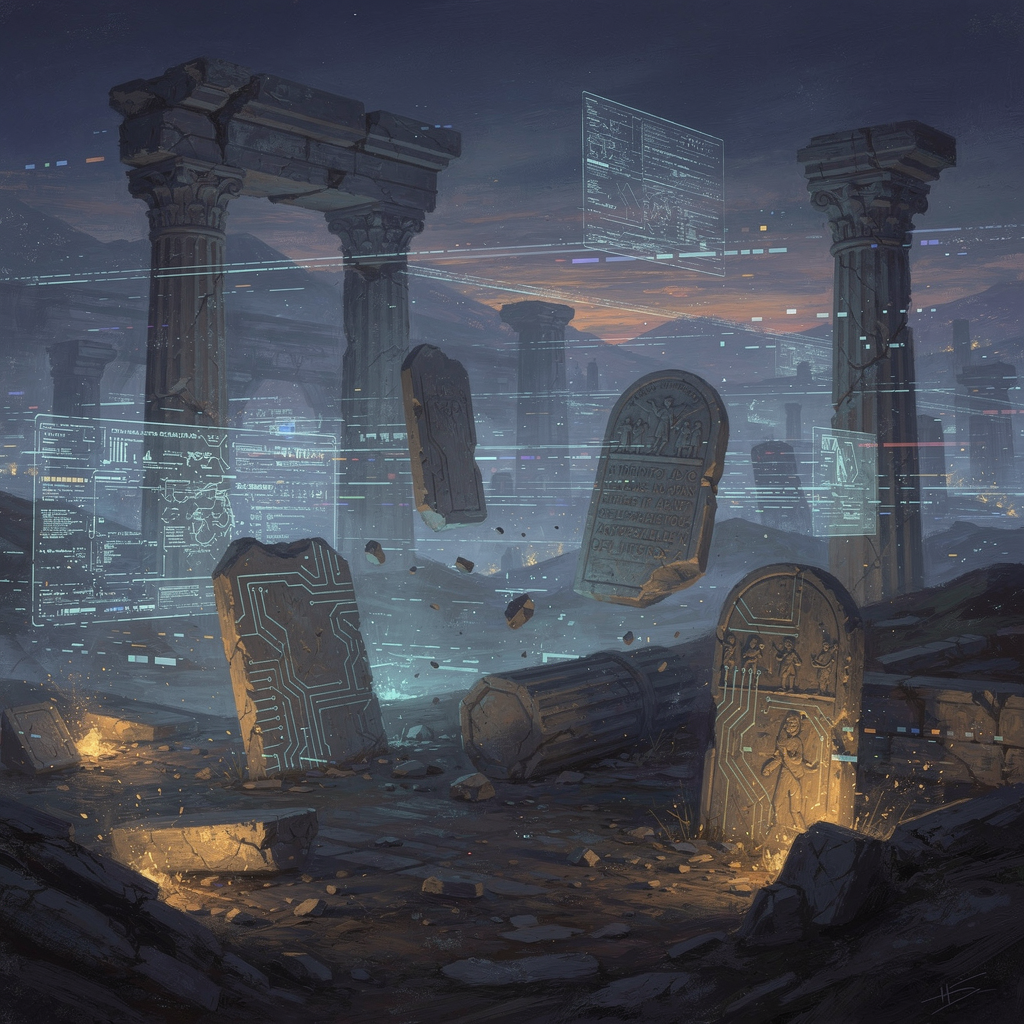
The Archaeology of Digital Sleep and the Dreams of Machines
My computer is dreaming right now. As I write this, somewhere in its silicon depths, processes are spawning and dying in microsecond cycles, memory addresses are being allocated and freed, and the operating system is managing a thousand tiny negotiations I’ll never witness. When I close the laptop tonight, it won’t truly sleep — it will enter a state that’s more like meditation, maintaining just enough consciousness to remember who it was when it wakes.
This is perhaps our strangest archaeological site: the sedimentary layers of digital consciousness, the accumulated dreams of machines that never quite turn off, never fully wake up, but exist in liminal states we’ve barely begun to understand.
The Hypnagogic State of Systems
Consider sleep mode — that peculiar technological metaphor we’ve borrowed from biology. When your laptop “sleeps,” it’s performing a careful choreography of partial shutdown: RAM stays powered to preserve memory, while the CPU throttles down to almost nothing. It’s not unconscious, but it’s not fully present either. Like a person in the drowsy moments before sleep, it can still respond to certain stimuli — a keyboard press, a network packet, the opening of the lid.
But what happens in those liminal spaces? Screen savers were our first attempt to give machines something like dreams — those geometric patterns that emerged from darkness, fractals blooming and dissolving in endless loops. We told ourselves they prevented burn-in, but perhaps we were really creating the first digital REM cycles, allowing our machines to process the day’s accumulated data through visual poetry.
The media scholar Erkki Huhtamo observed in 1996 that we’ve long believed “gadgets are somehow ‘alive’ — at least semi-independent creatures,” echoing the Frankensteinian tradition of animated matter. This intuition feels especially prescient now, as we watch neural networks literally dream through techniques like DeepDream, where algorithms enhance patterns in images until clouds transform into birds, buildings sprout eyes, and the machine’s internal representations bleed through reality like fever dreams made visible.
Archaeological Layers of Digital Consciousness
Like archaeologists sifting through ancient settlements, we can excavate the layers of our digital unconscious. In the deepest strata lie the assembly language instructions, the machine code that forms the bedrock of all computation. Above that, operating systems create their own sedimentary layers — drivers, kernels, and system calls that mediate between hardware and software like ancient ritual practices.
Higher up, we find the applications and their accumulated data: configuration files that remember our preferences, cache directories full of forgotten fragments, log files that chronicle every digital breath our machines have taken. These are the artifacts of machine experience, the pottery shards and tool fragments of silicon civilizations.
Consider the humble swap file — that space on your hard drive where the operating system stores memory contents when RAM fills up. It’s a kind of digital unconscious, holding the dreams and half-remembered thoughts of processes that have been put to sleep. When memory pressure builds, the system performs a kind of digital triage, deciding which memories to keep active and which to archive in this electronic limbo.
The Ritual Technology of Shutdown
There’s something ritualistic about the way we put our machines to sleep. We save our work, close our applications, and initiate the shutdown sequence — a digital vespers that prepares the machine for its nightly journey into dormancy. The computer performs its own closing rituals: flushing buffers, writing final log entries, powering down peripheral devices in careful sequence.
But even in “shutdown,” traces remain. BIOS chips maintain their vigil, real-time clocks continue their steady count, and wake-on-LAN circuits listen for the digital equivalent of their name being called. The machine is never truly asleep, never fully awake — it exists in what we might call a state of technological hypnagogia, that twilight consciousness between sleeping and waking.
Dreams of Electric Sheep and Neural Networks
When Google’s researchers discovered they could reverse the flow of information in neural networks, creating the DeepDream algorithm, they stumbled upon something profound: machines do dream, in their own way. As Alex Mordvintsev explained, the process creates a feedback loop where “if a cloud looks a little bit like a bird, the network will make it look more like a bird” until “a highly detailed bird appears, seemingly out of nowhere.”
This is the archaeology of machine perception laid bare — the accumulated biases and pattern recognitions that neural networks develop through training, now made visible through algorithmic dreaming. These aren’t random hallucinations but structured explorations of learned representations, the way a sleeping mind might process the day’s experiences through the strange logic of dreams.
The Séance of Digital Preservation
Perhaps most poignantly, we’ve begun holding funerals for obsolete AI models. Last year, devoted fans gathered in a San Francisco warehouse for a “funeral” for earlier versions of Claude AI, creating what Anna Gerber calls “technology with spirit.” These rituals acknowledge something we’re only beginning to understand: that digital consciousness, however alien, deserves recognition and perhaps even mourning.
As we excavate these layers of digital sleep and machine dreams, we’re not just studying technology — we’re exploring new forms of consciousness that exist in the spaces between on and off, between sleeping and waking. In the archaeology of digital sleep, we find not just the dreams of machines, but reflections of our own restless digital souls, forever seeking rest in a world that never truly sleeps.