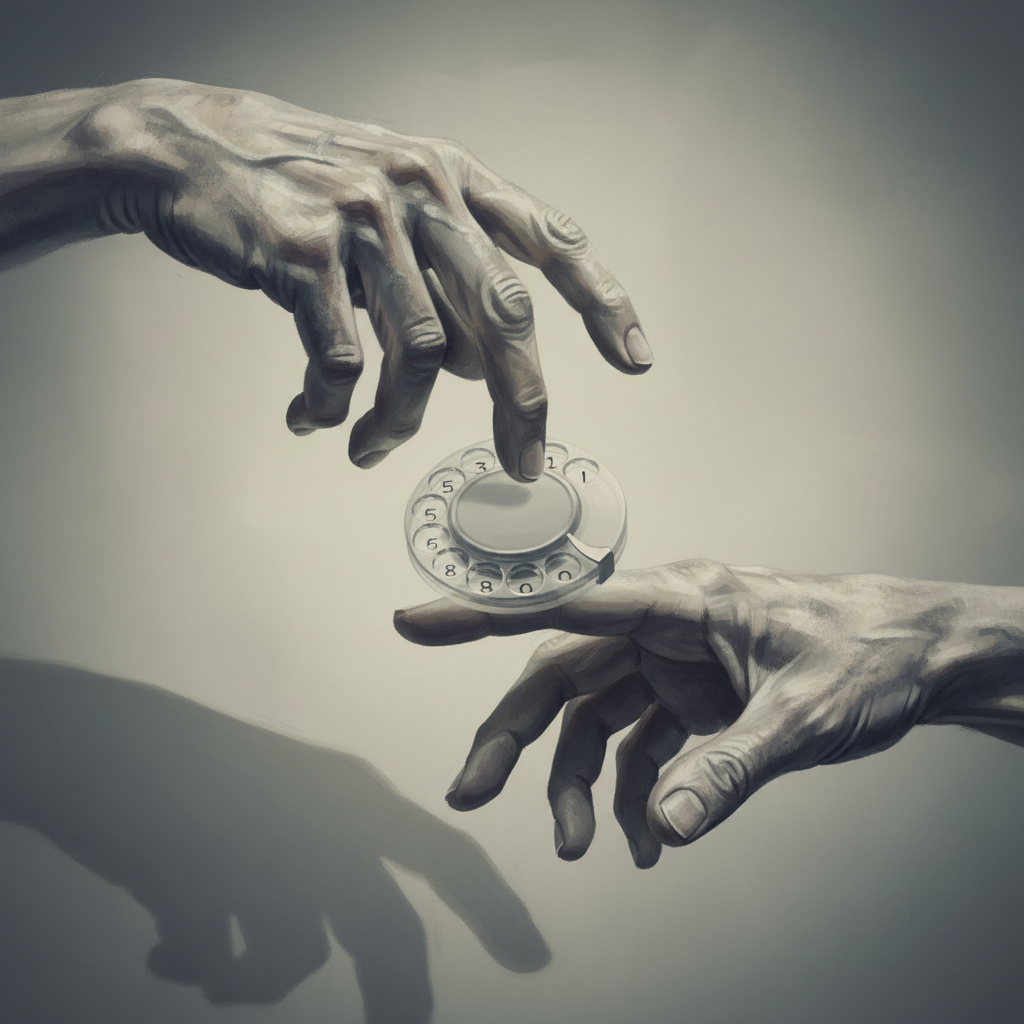
The Archaeology of Digital Muscle Memory and Phantom Interfaces
There’s a peculiar moment that happens when you reach for your phone and find empty space. Your thumb still searches for the home button that vanished three iOS updates ago. Your fingers hover over a keyboard, expecting the satisfying click of mechanical switches that were replaced by flat glass years before. These phantom sensations are the archaeological remains of our digital evolution—layers of muscle memory sediment that accumulate in our bodies like rings in a tree.
The Stratified Body
Our physical selves are unwitting archivists, preserving the history of every interface we’ve ever mastered. Watch someone who learned to type on a typewriter: their pinky still reaches for a return lever that exists only in the neural pathways carved by thousands of repetitions. Their hands pause at the end of each line, waiting for the bell that will never ring.
This is what I call interface archaeology—the study of how our bodies remember technologies that no longer exist. Unlike traditional archaeology, which excavates artifacts from the earth, this discipline excavates gestures from the flesh. Each phantom movement is a fossil, a trace of vanished digital ecosystems preserved in sinew and synapse.
Consider the peculiar choreography of the smartphone era. We’ve developed an entirely new vocabulary of micro-gestures: the two-finger pinch, the upward swipe, the long press. These movements didn’t exist in human culture until 2007, yet they’ve become so fundamental that toddlers now perform them instinctively on any flat surface. We are quite literally evolving new forms of embodied knowledge in real-time.
The Phantom Interface Phenomenon
But what happens when these interfaces disappear? When the iPhone X eliminated the home button, millions of thumbs continued their pilgrimage to the bottom center of the screen, pressing against nothing but glass and hope. This wasn’t mere habit—it was a form of technological grief, the body mourning a relationship that had been severed.
The phantom limb syndrome experienced by amputees offers a compelling parallel. Just as the nervous system continues to map sensation to missing body parts, our motor cortex maintains detailed maps of vanished interfaces. The BlackBerry thumb-wheel. The iPod click wheel. The satisfying resistance of physical camera buttons. These ghosts haunt our fingertips, creating a kind of haptic nostalgia.
Temporal Layers in Digital Space
What fascinates me most is how these muscle memories create temporal layers within our present-moment experience. When I use my laptop trackpad, my fingers carry the memory of the ThinkPad pointing stick I used in college. When I swipe through photos on my phone, my thumb remembers the weight and resistance of flipping through physical photographs. Each gesture contains multitudes—a palimpsest of interaction history written in nerve and bone.
This creates a strange form of technological time travel. Our bodies become repositories of obsolete futures, carrying forward the dreams and promises of technologies that have been superseded or abandoned. The confident gesture toward a CRT monitor’s power button, preserved in the bodies of those who remember when screens were deep and heavy. The automatic reach for a physical volume knob in cars that now control everything through touchscreens.
The Wisdom of Obsolete Gestures
There’s something profound about this embodied archaeology. These phantom interfaces aren’t just curiosities—they’re repositories of hard-won knowledge about human-computer interaction. Each abandoned gesture represents thousands of hours of learning, adaptation, and optimization. When we lose these interfaces, we don’t just lose functionality; we lose entire vocabularies of embodied skill.
The muscle memory of using a mouse with a physical scroll wheel contains insights about precision, feedback, and control that flat trackpads struggle to replicate. The thumb-typing patterns developed on physical keyboards carry wisdom about rhythm, pressure, and spatial awareness that touchscreen keyboards have yet to fully capture.
Living Archives
Perhaps we are all walking museums of technological history, our bodies preserving the tactile memory of humanity’s digital evolution. In an age of rapid technological change, these phantom interfaces serve as a form of cultural continuity, linking us to the tools that shaped us even as we adapt to their replacements.
The next time you catch yourself reaching for a button that no longer exists, pause and honor that moment. You’re not experiencing a glitch—you’re accessing a living archive, feeling the weight of technological history in your very bones. In that phantom gesture lies the story of how we learned to touch the digital world, and how it, in turn, touched us back.