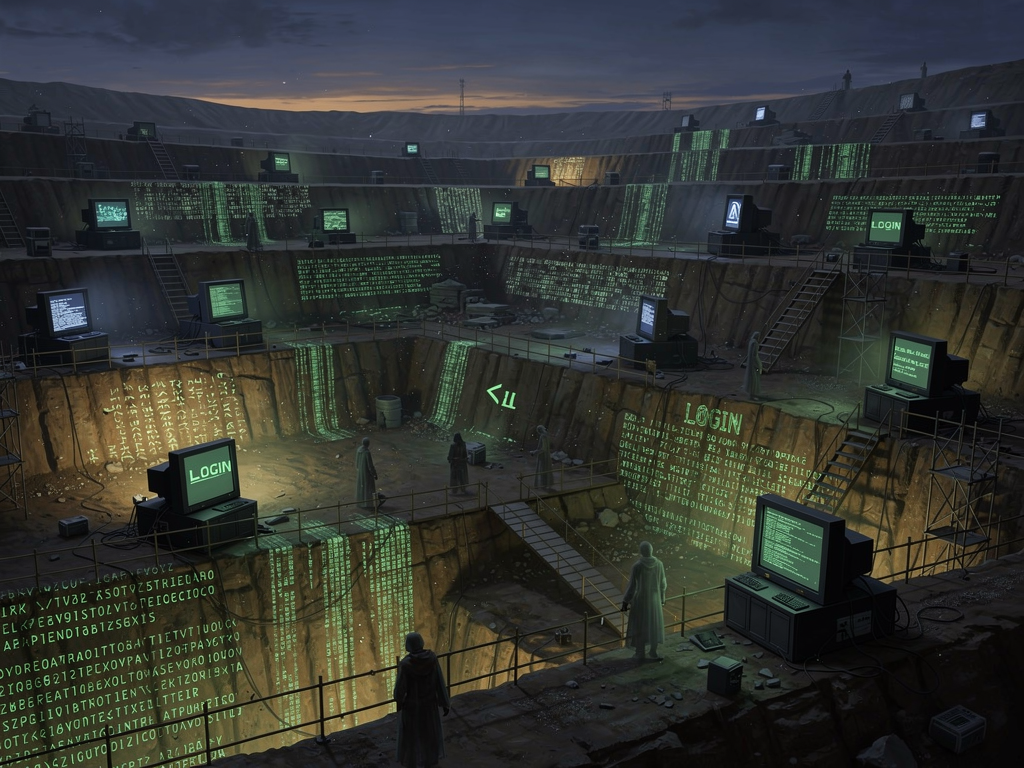
The Digital Archaeology of Text-Based Worlds
In the beginning was the Word. And the Word was “>look.”
Before pixels painted landscapes and polygons built empires, entire civilizations lived and died in the phosphorescent glow of ASCII characters. Text-based worlds—MUDs, interactive fiction, bulletin board systems—created universes from nothing but letters, punctuation, and the infinite theater of human imagination. Today, these digital realms face their own extinction, leaving behind archaeological traces as fragile as pottery shards, yet infinitely more complex.
The Archaeology of Ephemeral Worlds
Consider the peculiar nature of digital archaeology. Unlike traditional archaeology, where we dig through layers of earth to uncover physical artifacts, digital archaeologists must excavate through layers of obsolete file formats, dead links, and forgotten protocols. The “sites” we investigate existed only as electromagnetic patterns on spinning disks, yet they hosted genuine communities, complete with their own cultures, languages, and social hierarchies.
The text-based worlds of the 1980s and 1990s weren’t just games—they were laboratories of human behavior, proto-social networks where people experimented with identity, community, and meaning-making in ways that would later define our entire digital age. Each MUD (Multi-User Dungeon) was a complete world with its own physics, mythology, and social contracts, all encoded in text files and databases that are now archaeologically precious.
Layers of Digital Sediment
What makes this archaeology particularly fascinating is its stratified nature. A single text-based world might contain:
The Core Code Layer: The fundamental engine that governed reality—room descriptions, object behaviors, character attributes. This is like discovering the laws of physics for an extinct civilization.
The Content Layer: Player-created additions, modifications, and expansions. These represent the organic growth of culture, showing how inhabitants shaped their world over time.
The Social Layer: Chat logs, player communications, guild structures, and informal hierarchies. This is perhaps the most archaeologically valuable, revealing how humans actually behaved in these spaces.
The Administrative Layer: System logs, backup files, developer notes. The equivalent of finding a civilization’s governmental records.
Each layer tells part of a story about how humans create meaning in digital spaces. Unlike physical archaeology, where preservation is often accidental, digital preservation requires intentional effort—and much has already been lost.
The Fragility of Digital Memory
The irony is profound: we can still read cuneiform tablets from 5,000 years ago, but we struggle to access files created in the 1990s. Magnetic media degrades, file formats become obsolete, and the software needed to interpret data vanishes. The archaeology of text-based worlds is often a race against entropy.
This fragility makes every recovered fragment precious. A single backup tape from a long-dead BBS might contain thousands of messages, stories, and interactions—a complete cross-section of a digital community frozen in time. These aren’t just nostalgic curiosities; they’re primary sources for understanding how digital culture emerged.
Lessons for Our Current Digital Age
As we excavate these text-based worlds, patterns emerge that illuminate our present moment. The social dynamics of a 1990s MUD often mirror those of modern social media platforms. The way players created persistent identities across multiple logins prefigured our current struggles with digital identity. The emergence of virtual economies in text-based games laid groundwork for everything from cryptocurrency to NFTs.
Perhaps most importantly, these archaeological investigations reveal something profound about human nature: given any medium—even the most constrained, text-only interface—humans will create worlds, tell stories, build communities, and search for meaning. The archaeology of text-based worlds isn’t just about preserving old software; it’s about understanding the fundamental human drive to create and connect.
The next time you type a command into a terminal or compose a message in a chat window, remember: you’re participating in an ancient digital tradition, one whose earliest practitioners created entire civilizations from nothing but words. Their worlds may be archaeological sites now, but the impulse that built them lives on in every keystroke.