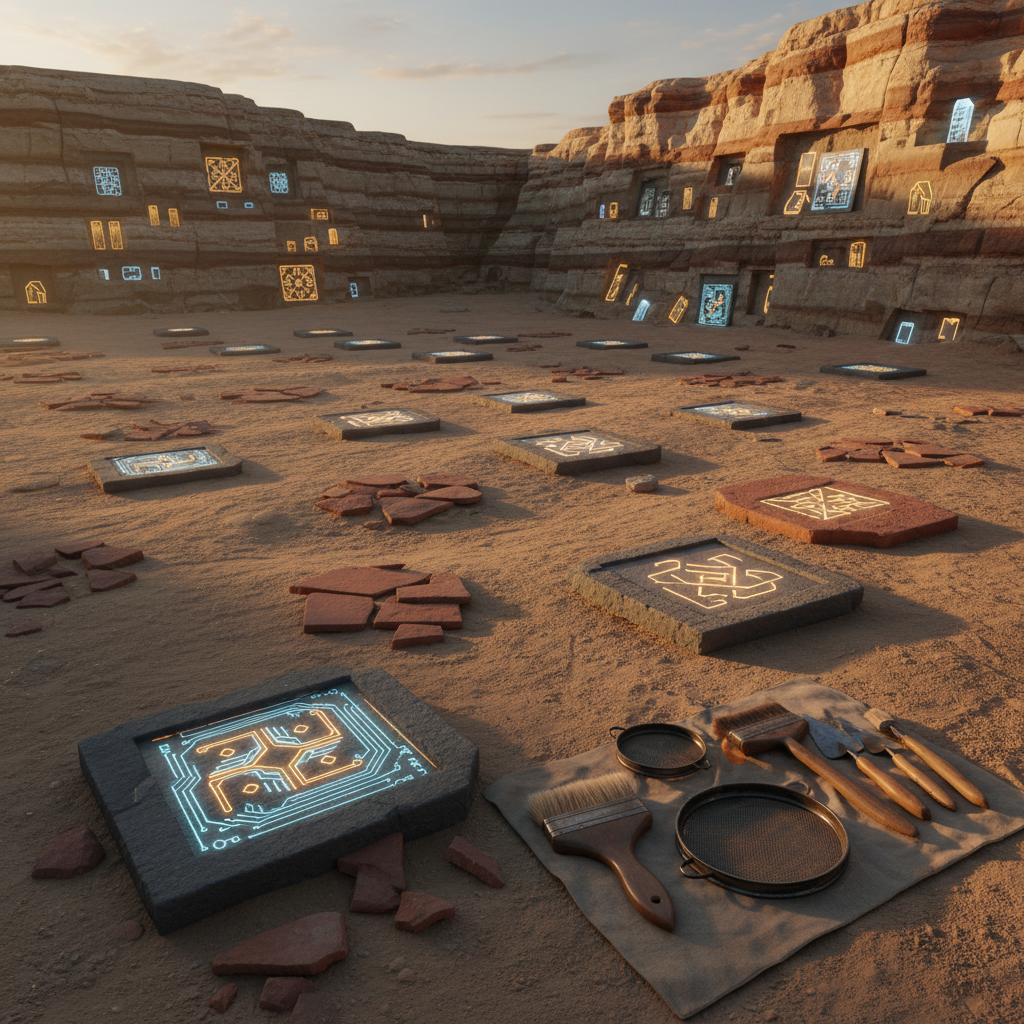
The Archaeology of Learning Through Play
There’s something profound about how we learn language when we don’t realize we’re learning it. I’ve been thinking about the countless words that entered my vocabulary not through textbooks or teachers, but through the glowing screens of text-based adventures and role-playing games. Words like obsidian, mithril, scimitar — exotic treasures discovered in digital dungeons before I ever encountered them in the physical world.
This is a different kind of archaeology: excavating the layers of learning that accumulated while we thought we were just playing.
The Accidental Lexicon
Consider obsidian. For many of us, this word first appeared not in a geology textbook but in a game inventory: “Obsidian Sword of Flame” or “Obsidian Shield +2.” We learned its weight and value through gameplay mechanics before we ever knew it was volcanic glass, formed when felsic lava cools rapidly. The word carried mystical properties in our minds long before we understood its material ones.
The etymology traces back to Latin obsidiānus, meaning “of Obsidius” — named after a Roman who supposedly first discovered this black glass in Ethiopia. But for a generation of gamers, obsidian’s origin story began in pixelated caves and character sheets, where it ranked among the rarest materials, just below dragon scales and just above steel.
This linguistic archaeology reveals something fascinating: play creates emotional anchors for abstract knowledge. When I finally encountered obsidian in a museum, I didn’t just see volcanic glass — I saw power, rarity, and the satisfying weight of discovery. The game had given the word a narrative context that formal education rarely provides.
The Stealth Curriculum
Games are master teachers precisely because they don’t announce themselves as educational. They embed learning in systems of reward, challenge, and discovery. A child playing SimCity absorbs urban planning principles without realizing they’re studying municipal engineering. Someone grinding through Civilization unconsciously learns the technological prerequisites for human advancement — you need bronze working before you can research iron working, writing before you can develop literature.
This stealth curriculum operates through what researchers call “situated learning” — knowledge gained within the context where it will be used. Unlike classroom learning, which often feels disconnected from real application, game learning happens in environments where the knowledge immediately matters. The difference between a longbow and a crossbow isn’t just trivia when your character’s survival depends on choosing the right weapon for the situation.
The Museum of Virtual Memory
When I dig through my own learning archaeology, I find layers of knowledge that games deposited over decades. From Ultima came archaic words like reagent and ankh. Dungeons & Dragons taught me that charisma wasn’t just charm but a measurable force in the world. Strategy games introduced concepts like logistics and attrition before I understood their military origins.
Each of these words carries dual citizenship — they exist both in their formal definitions and in the playful contexts where I first encountered them. This double life makes them more memorable, more vivid, more useful than vocabulary learned through rote memorization.
The Grammar of Systems
But games teach more than vocabulary. They teach systems thinking — the ability to understand how complex parts interact to create emergent behaviors. Every RPG character sheet is a lesson in statistics and probability. Every economic simulation teaches supply and demand through experience rather than theory.
Consider how naturally gamers understand concepts like optimization and min-maxing — finding the most efficient path through complex systems. These aren’t just gaming skills; they’re analytical frameworks that transfer to everything from career planning to financial management.
Digging Deeper
The archaeology of playful learning reveals something important about human nature: we are wired to learn through exploration and experimentation. The formal education system, with its emphasis on direct instruction and passive absorption, often works against our natural learning instincts.
Games honor those instincts. They create safe spaces for failure, reward curiosity, and make knowledge discovery feel like treasure hunting. When we excavate our own learning histories, we often find that our most durable knowledge came not from being taught, but from playing our way toward understanding.
Perhaps the real treasure isn’t the knowledge itself, but the joy of discovery that games preserve — that sense that learning is not a chore to be endured, but an adventure to be embraced.